
Ganesha Is Younger Than the Buddha - What Cave 7 at Lenyadri Proves
Start with the cave
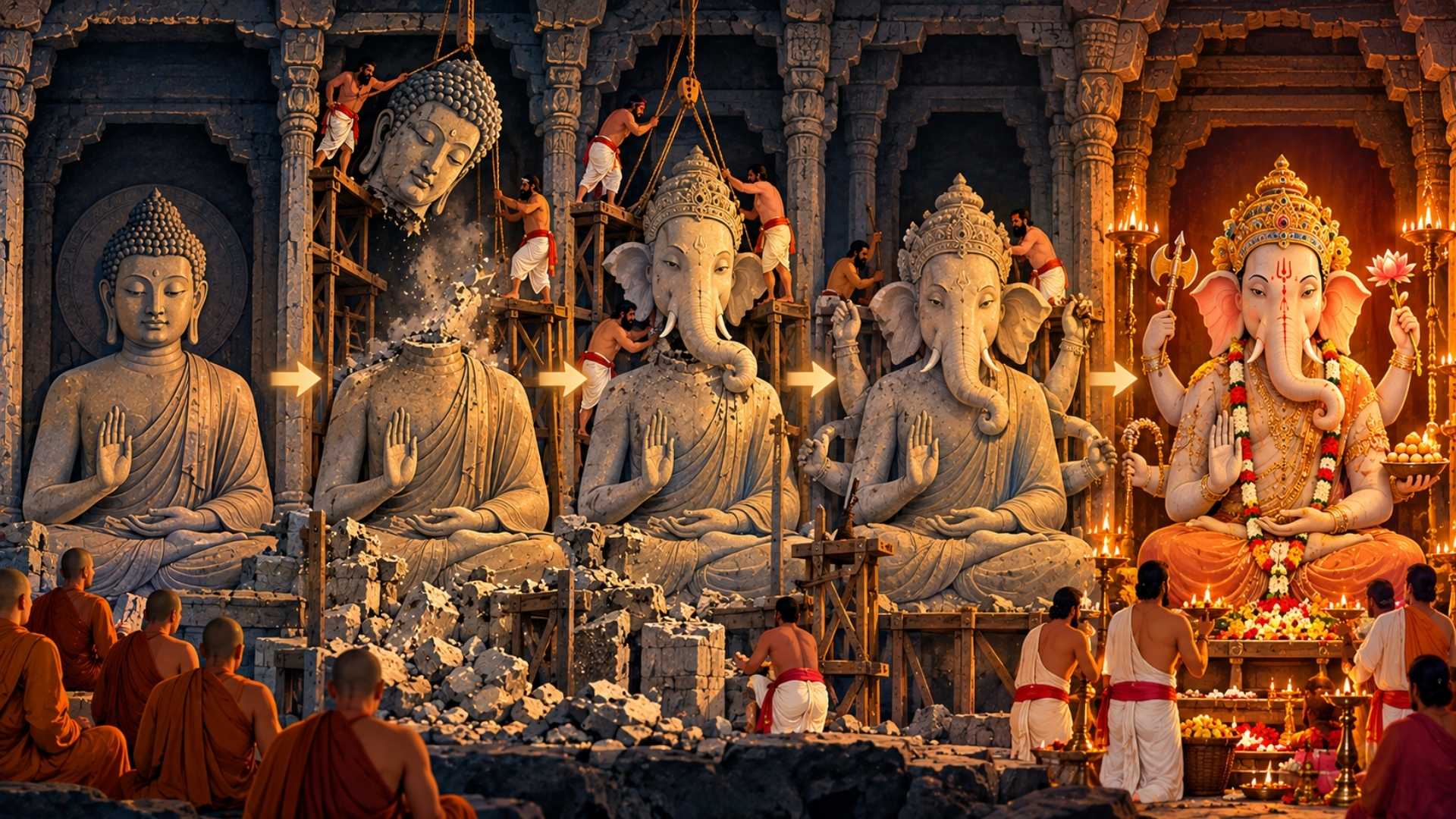
Near Junnar in Maharashtra there is a hill with about thirty rock cut caves, called Lenyadri. Buddhist monks carved them between the 1st and 3rd centuries CE, during the early Hinayana period, along a busy merchant trade route. Cave 7 was the largest of them: a vihara, basically a monks’ hostel, with a wide hall and twenty small cells.
Today Cave 7 is the Girijatmaj temple, one of the eight Ashtavinayak shrines of Maharashtra. Pilgrims are told Ganesha was born in this cave.
Both stories cannot be true in the order the legend gives. So let us check who got there first. Three pieces of evidence settle it.
There was no Ganesha in the Buddha’s India
Look for the elephant headed god in the Vedas and he is not there. Scholars broadly agree that Ganesha appears as a distinct, clearly recognisable deity only in the 4th to 5th centuries CE, in the Gupta period. The Buddha lived roughly 900 years before that. The historian R.G. Bhandarkar pushed it later still, noting that Ganapati is absent from Gupta period inscriptions.
Put simply: by the time Ganesha became a god, Buddhism was already old, organised and spreading across Asia.
His family tree begins with demons, not gods
The name Vinayaka first appears in the Manava Grihyasutra, and it is plural. Four troublesome spirits who created obstacles and suffering and had to be bribed into leaving you alone. The archaeologist A.K. Narain noted the word was used for a group of four lesser spirits, not for Ganesa at all. M.K. Dhavalikar traced how those four were later merged into one deity and promoted upward.
Buddhists remembered this. In Buddhist tantra there is a deity called Vighnantaka, the Ender of Obstacles, shown standing on top of Ganesha. To Hindus he removes obstacles. To early Buddhists he was the obstacle. Only much later was he absorbed and softened into a protector, as Kangiten in Japan and Maha Rakta Ganapati in Tibet.
The address was already taken
Back to Cave 7. Two of the central cells on the rear wall were knocked into one and fitted with a Ganesha shrine at an unknown later date. The entrances were widened and sockets were cut to fix wooden doors. The rest of the hall and the other cells were left exactly as the monks made them, which is why the original vihara plan is still visible.
Nobody built a Ganesha temple here. Somebody moved into a Buddhist one. Lenyadri is the only Ashtavinayak temple set inside a mountain cave, and the reason is not miraculous. The cave was already there, built by someone else, and it was free.
Ambedkar gave this pattern a name
Dr B.R. Ambedkar called it the counter revolution. In his unfinished Revolution and Counter-Revolution in Ancient India he argued that Buddhism was India’s equality revolution and that Brahmanism organised a takeover in reply. He dated the opening move to about 185 BCE, when Pushyamitra Shunga assassinated the Mauryan emperor Brihadratha and seized the throne. The full text is in BAWS Volume 3.
He was consistent about it to the end. At Deekshabhoomi in Nagpur on 14 October 1956, he administered 22 vows to roughly six lakh people converting to Buddhism. Vow three names the deity directly: no faith in Gauri, Ganapati and other Hindu gods and goddesses. That was not random. It was a historical claim written as a pledge.
Now the other side, because a good argument survives it
Most academic archaeologists do not call this a theft. They call it syncretism: a slow blending as trade wealth shifted from monasteries to temples over centuries. They point out that the date of conversion at Lenyadri is genuinely unknown, that these caves sat on routes where many faiths mixed, and that elephant headed figures existed in folk yaksha cults that owed nothing to Buddhism. Hindu tradition replies with the Ganesha Purana, which names Lenyadri as the birthplace.
Take that seriously. Then notice what it does not do. It does not move Ganesha earlier than the Buddha. It does not make the shrine older than the vihara. Whether the takeover was violent or gradual is a real and open debate. Whether there was a takeover is not.
Why should we care
Because this is how history gets edited: not by burning the evidence, but by putting a new name on it and repeating the new name for a thousand years. The stone at Junnar never lied. It just stopped being read. Learning to read it is what Ambedkarite history actually trains you to do, and it is a skill that works on far more than caves.
Go check one claim in this article yourself. Then bring what you find to the community at Unify the Lit.