
When the Wound Is Older Than You: Understanding the Lasting Psychological Damage of Caste
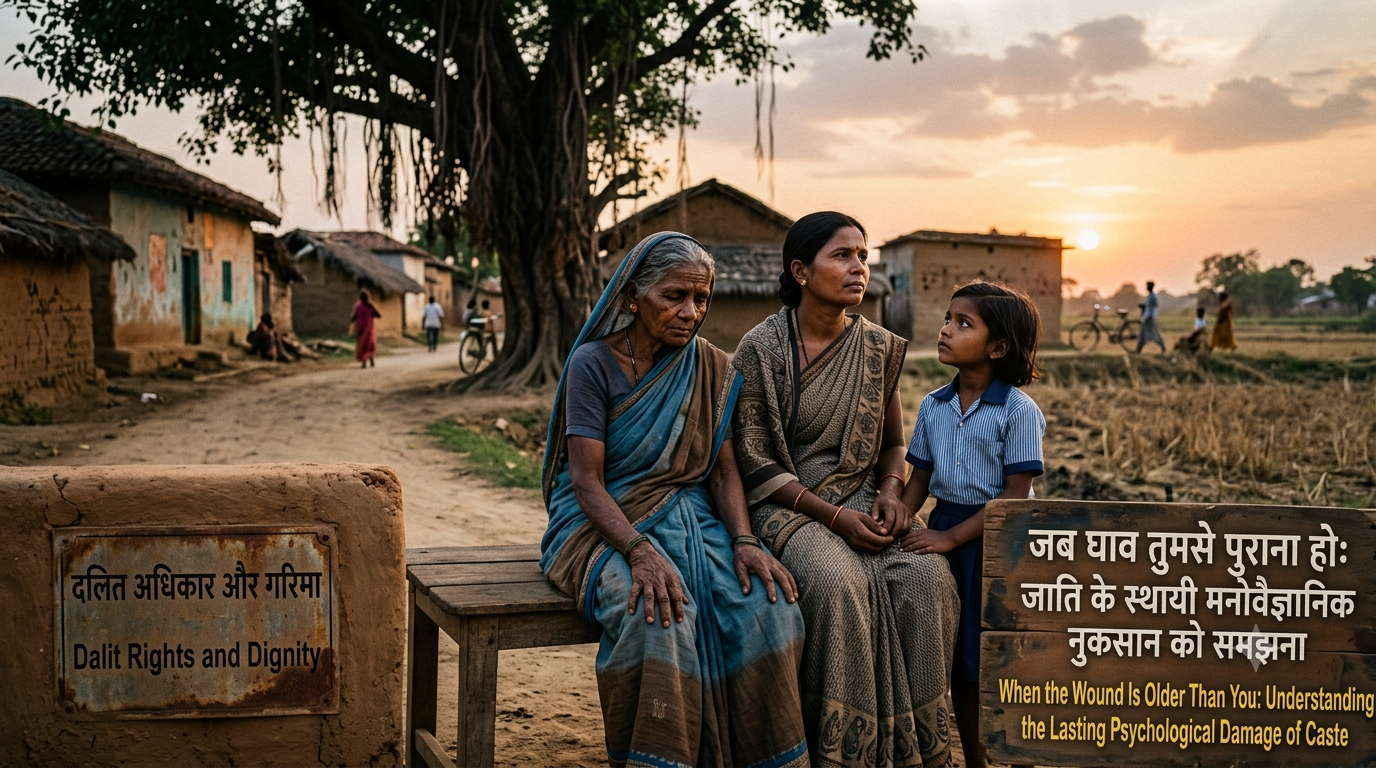
There is a kind of hurt that does not begin with you.
It begins with your parents. Or their parents. Or the ancestors before them who were told by law, by scripture, by the iron weight of custom that they were lesser. That they were polluted. That they did not deserve to sit where others sit, drink where others drink, or dream what others dream.
That hurt travels through time. It lives in the body. It shapes how a child sees herself before she has even read a single page of Ambedkar.
A 2025 research paper by Dr. Anoop Kumar Koileri V, Assistant Professor of Psychology at Ambedkar University Delhi and Deputy Director at the National Commission of Scheduled Castes, puts the clinical weight of psychology behind what Dalit communities have always known in their bones. This article summarises his findings in plain language for Dalit readers, for allies, for anyone who wants to understand why healing requires more than just legal reform.
Where It All Began: The History in 60 Seconds
The Varna system was born in the Vedic period (roughly 1500–500 BCE). What may have begun as a loose division of roles priests, warriors, merchants, labourers hardened over centuries into a birthright hierarchy. By the time the Manusmriti was written (around 500 BCE–200 CE), the idea of "purity and pollution" had pushed an entire section of people outside the caste system entirely. These were the people labelled "untouchables" what we now call Dalits.
British colonial rule made it worse by locking caste into official records and governance. The Indian Constitution of 1950, through Article 17, abolished untouchability and introduced reservations. But legal abolition is not the same as psychological healing and that gap is exactly what this research addresses.
What Is Intergenerational Trauma?
"Intergenerational trauma" means exactly what it sounds like: trauma that travels across generations.
When a parent has lived under fear, humiliation, and violence, those experiences don't vanish when they have children. They shape how parents raise their children. They affect the emotional stability of the home. They pass on through the stories families tell, the silences they keep, the way they flinch, the warnings they give.
Research in epigenetics the science of how environment affects gene expression now suggests that severe, prolonged stress can even alter how genes behave in future generations, making them biologically more susceptible to anxiety and depression.
For SC/ST communities in India, this is not a metaphor. It is centuries of accumulated trauma now living in the nervous systems of today's generation.
What Does This Trauma Actually Look Like?
Dr. Koileri's paper identifies six major psychological effects. Each one is worth sitting with.
1. Low Self-Worth and Internalized Inferiority
When a community is told, generation after generation, that it is inferior some part of that message gets believed. This is called internalized oppression: the oppressor's voice becomes your own inner voice.
It shows up as self-doubt, reduced ambition, and a quiet but devastating feeling that you don't quite deserve the opportunities you earn. Even Dalit professionals who achieve success often experience imposter syndrome a persistent sense that they don't really belong in the room they've worked so hard to enter.
2. Chronic Fear, Anxiety, and Hypervigilance
Living in a social environment where humiliation, exclusion, or violence can arrive at any moment creates a nervous system permanently on alert. This is called hypervigilance the body's threat-detection system stays switched on even when there is no immediate danger.
This leads to social withdrawal, reluctance to participate in public or professional life, and defensive behaviour around dominant-caste groups. It is not shyness. It is a rational adaptation to a world that has punished visibility.
3. Educational and Career Aspirations Cut Short
The research shows that SC/ST students often carry lower academic self-confidence not because of lack of intelligence, but because of a system that has historically told them they don't belong in it. Discrimination in schools, bullying, absence of role models in the family or immediate community, and learned helplessness (the feeling that effort won't change outcomes) combine to produce higher dropout rates and limited career aspiration.
This is a direct wound from the caste system measurable in lost human potential across millions of lives.
4. Depression, Anxiety, and PTSD
Long-term discrimination and exclusion significantly increase the risk of clinical depression, anxiety disorders, and post-traumatic stress disorder (PTSD). Yet the communities most affected are the least served: financial barriers and the stigma attached to mental illness in India mean most SC/ST individuals never access mental health support at all.
5. Loss of Cultural Identity
For Adivasi (ST) communities especially, forced displacement and cultural assimilation have stripped away language, ritual, and belonging. For Dalit communities, centuries of being forced to hide or feel shame about identity creates what the paper describes as rootlessness a psychological dislocation from one's own heritage.
Ambedkar understood this. The reclamation of Buddhist identity and Dalit cultural pride was, among other things, an act of psychological repair.
6. The Cycle of Poverty and Marginalization
Economic deprivation and psychological damage reinforce each other in a downward spiral. Limited opportunities reduce motivation. Reduced motivation keeps people in limited circumstances. The cycle becomes intergenerational a family pattern of learned helplessness that is not a character flaw but a structural wound.
What Does Healing Actually Require?
Dr. Koileri's paper is clear: healing cannot come from law alone. It requires a multi-layered response.
Mental Health Access Caste-sensitive counselling and therapy must be made accessible and affordable. Community-led support groups that create safe spaces to name and process caste trauma are not a luxury; they are a necessity. Trained, caste-aware psychological counsellors should be posted in institutions that serve SC/ST populations.
Representation and Role Models Seeing yourself reflected in leadership, in media, in institutions matters enormously. The absence of role models in the immediate community is one mechanism by which low aspiration travels across generations.
Educational Reform Schools must be made genuinely inclusive not just in policy but in daily practice. Caste-based bullying, teacher bias, and a curriculum that erases Dalit and Adivasi history must be actively addressed.
Economic Empowerment Scholarships, skill development, entrepreneurship support, and job security are not just economic interventions. They break the cycle of helplessness at its material root.
Cultural Reclamation Dalit and Adivasi cultural heritage is not a relic. Strengthening it, documenting it, and teaching the history of resistance from the Adi Dharma movement to the Mahad Satyagraha to the drafting of the Constitution is an act of psychological restoration.
Legal Enforcement Anti-discrimination laws exist. They must actually be enforced. The absence of legal accountability is its own form of ongoing trauma.
The Bigger Argument
This research paper is making a point that should reshape policy conversations in India.
Reservations, legal protections, and economic schemes are necessary but they are not sufficient. The psychological dimension of caste violence has been largely invisible in public policy. You cannot build a just society while ignoring the inner lives of the people who were most damaged by injustice.
As Ambedkar wrote, the problem of caste is not just about material conditions. It is about annihilating the idea in law, in social practice, and in the minds of those who were taught to believe their own inferiority.
Healing the psyche from caste violence is, in this sense, the unfinished business of the Indian Constitution.
In Closing
If you are Dalit, if you are from an Adivasi community, if you have ever felt that quiet weight of self-doubt that no one in your family quite had the words for this research is saying: it is not you. It is history. It is a system. And it is real enough to be studied, measured, named.
Naming it is the first step toward dismantling it.
Jai Bhim. 💙
Original Research Paper: Koileri, V.A.K. (2025). Healing The Psyche from Caste Violence: Addressing the Cumulative Psychological Trauma of Generations of Oppression and Deprivation Among the SC/ST Community in India.International Journal of Indian Psychology, 13(2), 1385–1391.
Full paper available here: https://ijip.in/wp-content/uploads/2025/05/18.01.125.20251302.pdf
Pass it forward
Know someone who needs stories like this? Bring them into the movement through our Referral Circle.
 Join the Referral Circle