382 People Took Our Caste Consciousness Index. Here's What We Learned About How India Understands Caste.
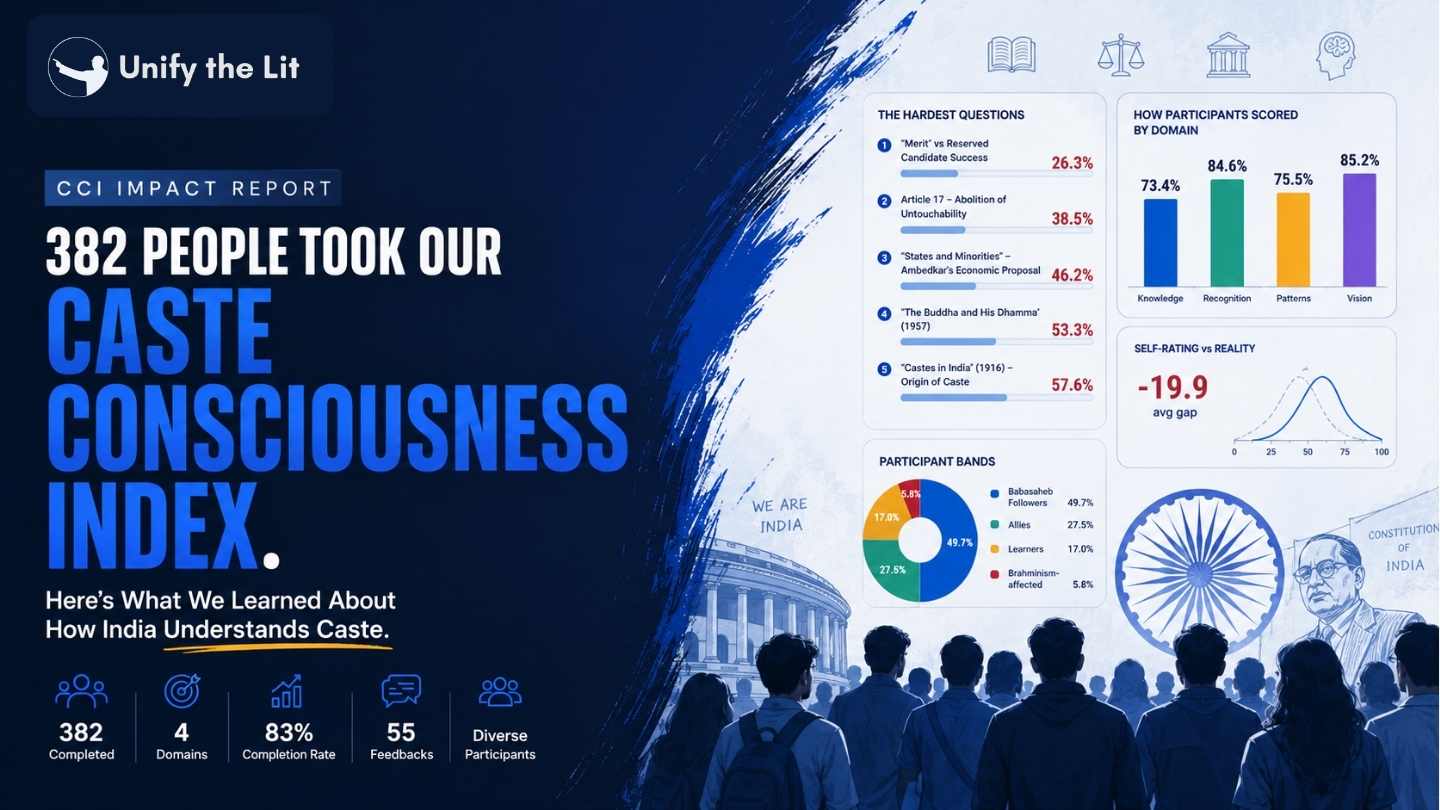
Over the past few weeks, hundreds of people from different backgrounds visited Unify the Lit to take our Caste Consciousness Index (CCI) an assessment designed to measure not intelligence, but awareness.
We expected the results to help us improve the quiz.
Instead, they became something far more interesting.
They showed us where people understand caste remarkably well, where knowledge begins to fade, and which conversations India still hasn't had enough of.
Whether you identify as Dalit, Bahujan, Adivasi, OBC, Savarna, or simply someone curious about India's social history, these findings aren't about labels.
They're about learning.
What is the Caste Consciousness Index?
The CCI was built around one simple question:
How well do we actually understand caste not as opinion, but as history, constitutional values, lived realities, and social patterns?
Unlike conventional quizzes that reward memorisation, the CCI evaluates understanding across four different dimensions:
- Knowledge – historical facts, constitutional provisions and Ambedkar's writings.
- Recognition – identifying caste realities in everyday life.
- Patterns – recognising recurring social narratives and biases.
- Vision – understanding the long-term ideas behind equality, dignity and social transformation.
The objective isn't to pass or fail.
It's to discover blind spots.
382 Assessments Later...
Over the study period:
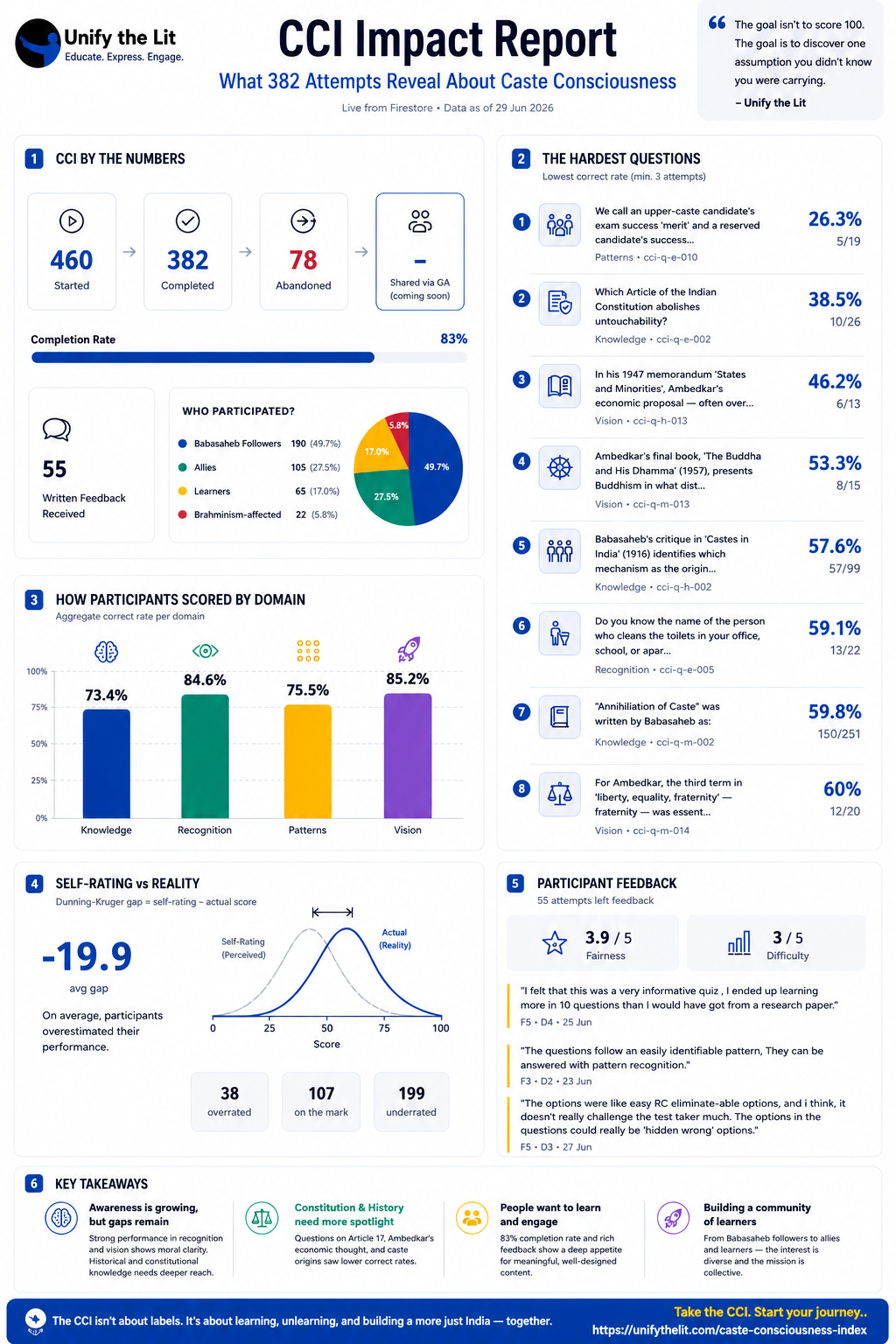
- 460 people started the assessment.
- 382 completed it.
- 78 left midway.
- 55 participants voluntarily left written feedback.
Perhaps the most encouraging statistic wasn't any score.
It was the 83% completion.
For an educational assessment containing nuanced questions about history, constitutional law and social realities, this suggests something important:
People are willing to engage with thoughtful content when it's presented in an accessible and respectful way.
That is encouraging for everyone who believes education can still change conversations.
We Know More Than We Think… But Less Than We Assume
One of the most fascinating insights came from comparing how participants rated themselves before the assessmentwith how they actually performed.
On average, participants overestimated their performance by nearly 20 points.
Psychologists often describe this tendency as a confidence gap—when familiarity with a topic creates the illusion of deeper understanding.
Interestingly, this isn't unique to caste.
It appears in finance, politics, science, and even medicine.
The CCI simply reminds us that complex social issues deserve curiosity more than certainty.
Recognition Is Strong. Historical Knowledge Needs More Attention.
One encouraging pattern stood out immediately.
Participants demonstrated a strong ability to recognise social realities.
The highest-performing domains were:
- Vision: 85.2%
- Recognition: 84.6%
People generally understood the values of dignity, equality and justice.
Where performance dropped was in historically grounded knowledge.
- Knowledge: 73.4%
- Pattern Recognition: 75.5%
This suggests many people already possess the moral intuition required to oppose discrimination.
What often remains missing is historical context.
Understanding why these realities exist is just as important as recognising that they do.
The Questions That Challenged Almost Everyone
Some questions surprised us not because they were difficult to write, but because we expected them to be widely known.
The lowest-scoring questions included:
- constitutional provisions abolishing untouchability,
- Babasaheb Ambedkar's lesser-known economic ideas,
- the origins of caste discussed in Castes in India (1916),
- interpretations of The Buddha and His Dhamma,
- and the social language surrounding "merit."
The most challenging question achieved a correct response rate of just 26.3%.
One particularly striking finding was that fewer than four in ten participants correctly identified the Constitutional Article that abolishes untouchability.
That isn't a criticism of participants.
It is a reminder that constitutional literacy still has room to grow.
Learning Doesn't End With School
Many participants described the assessment as something they hadn't encountered elsewhere.
One participant wrote:
"I ended up learning more in ten questions than I would have from a research paper."
Another observed:
"Not everyone is expected to know the intricacies of historical events. What matters is the moral standpoint."
The goal of the CCI has never been to create difficult questions simply for the sake of difficulty.
The goal is to create moments where people pause and rethink assumptions they may have carried for years.
A Community That Wants To Learn
Another encouraging trend emerged from participant categories.
Nearly half of completed assessments came from people identifying themselves as followers of Babasaheb Ambedkar.
But a significant proportion came from allies and learners who simply wanted to understand caste more deeply.
That matters.
Because conversations about caste shouldn't remain confined to those directly affected by it.
Building a more equal society requires shared understanding.
Education becomes stronger when people choose curiosity over defensiveness.
What These Numbers Really Mean
The analytics tell a hopeful story.
They suggest people are not avoiding difficult conversations.
They are looking for trustworthy spaces where those conversations can happen thoughtfully.
They also remind us that awareness isn't binary.
Someone may understand discrimination deeply while knowing very little constitutional history.
Another person may know historical events but miss subtle social patterns that still shape everyday life.
Education isn't about collecting facts.
It's about connecting them.
Why Unify the Lit Built the CCI
At Unify the Lit, we believe dignity begins with knowledge.
The Caste Consciousness Index isn't designed to tell anyone whether they're "good" or "bad."
It's designed to encourage reflection.
To replace assumptions with understanding.
To replace certainty with curiosity.
And perhaps most importantly, to make conversations about caste more informed, more respectful, and more human.
The Real Score Isn't 100
If there's one lesson we took away from analysing 382 completed assessments, it's this:
The purpose of learning isn't to prove how much we already know.
It's to discover what we still have left to understand.
That's true whether you're a student, professional, educator, policymaker, or someone encountering these ideas for the first time.
The CCI doesn't ask whether you belong to a particular community.
It asks whether you're willing to learn.
And that may be the most important question of all.
Take the Caste Consciousness Index
Think you know the history, the Constitution, and the ideas that continue to shape modern India?
Take the assessment, compare your expectations with reality, and discover something new.
Liked this story?
Discover more voices from the Dalit storytelling archive, reflections, struggles, and steps to transform our future.
Browse all storiesPass it forward
Know someone who needs stories like this? Bring them into the movement through our Referral Circle.
 Join the Referral Circle