
The Cost of Equilibrium: Why We Manufacture the "Broken" to Keep the System Whole
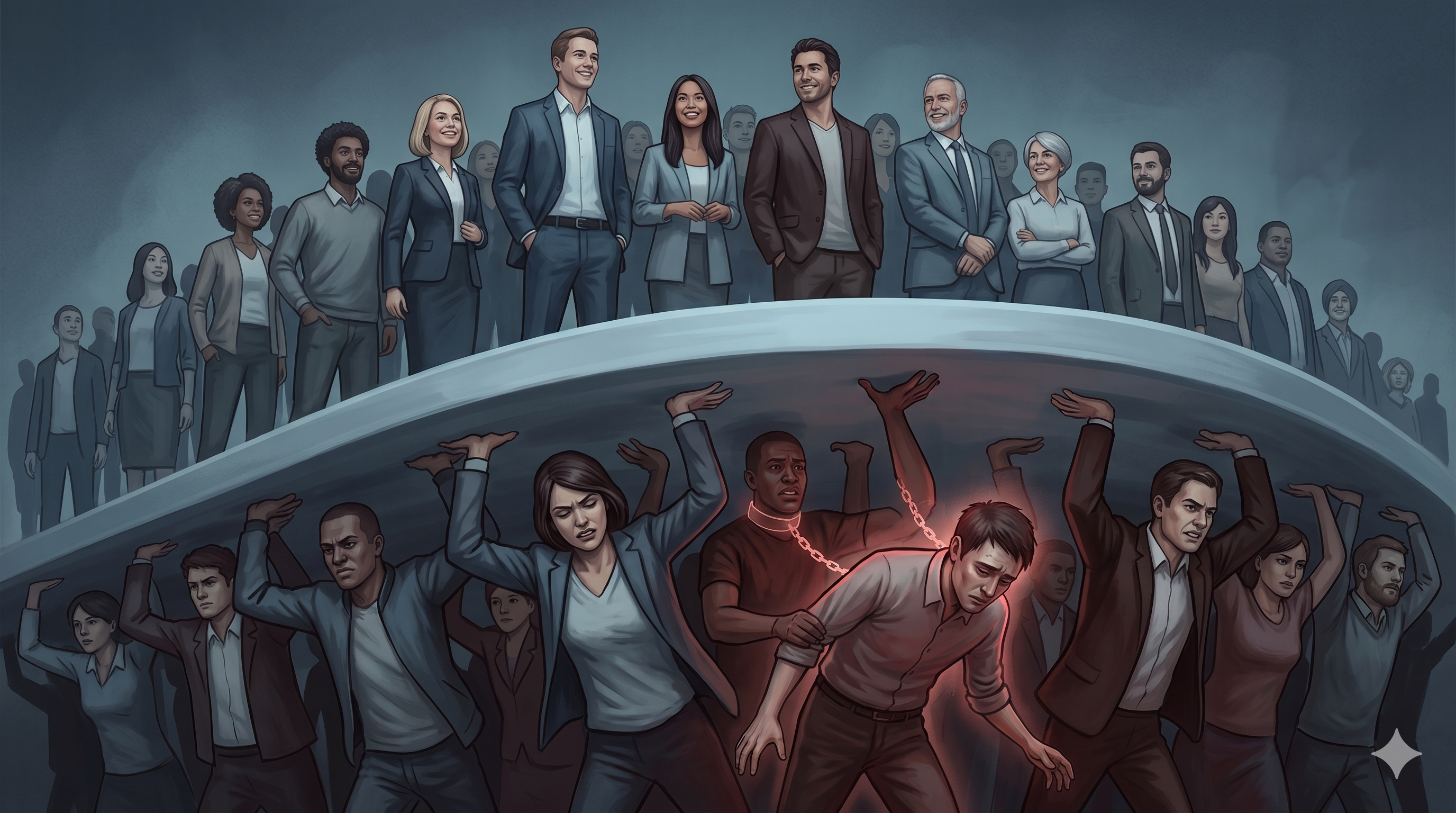
When we look at social hierarchies, dysfunctional family dynamics, or systemic exclusion, our natural inclination is to view them as structural failures. We see the marginalized, the family "black sheep," or the individual struggling with mental health as tragic casualties of an otherwise functioning world.
But a deeper look across sociology, psychology, and history reveals a far darker truth: these casualties are rarely accidental. They are functional.
To survive in highly competitive, high-pressure environments, human groups frequently exhibit a primal, unconscious reflex the urge to pull oneself upward by pushing someone else down. To anchor their own sense of "normalcy," sanity, or superiority, groups often require a designated contrast. They manufacture a broken character so that everyone else can feel whole.
The Intimate Mirror: The Micro-Scapegoat
In small, closed circles like an extended family or a tight-knit friend group there is often a single character collectively labeled as the most unstable, volatile, or "fucked up." This assignment is rarely a conscious conspiracy; it is an act of unconscious collective preservation.
French philosopher René Girard identified this as the Scapegoat Mechanism. Girard argued that human communities naturally accumulate internal tension, jealousy, and rivalry. If left unchecked, this friction will tear the group apart. To survive, the group instinctively deflects this chaotic energy onto a single target.

By collectively designating one person as "the problem," the rest of the group achieves instant unification. The scapegoat bears the burden of the group’s hidden anxieties. When family members point at the "damaged" relative and mutely agree that they are the unstable element, they create an immediate boundary for themselves: "As long as they are the crazy one, we are sane."
This dynamic is reinforced by Erving Goffman’s work on Stigma. Goffman showed how social groups manage "spoiled identities" by marking specific individuals as flawed or discreditable. This marking allows the "normals" to validate their own identity, establishing a comfortable psychological baseline at the outcast's expense.
The Macro-Matrix: Systemic Deflection and Caste
This micro-level instinct to push others down for collective survival expands into massive, rigid societal structures when multiplied across populations. The most stark, historical manifestation of this is the caste system.
In his seminal 1936 text Annihilation of Caste, Dr. B.R. Ambedkar dissected how Indian caste society operates not merely as a division of labor, but as a hierarchical psychological fortress. A caste system is a system of "graded inequality" where every tier finds psychological comfort in the existence of a tier below them.
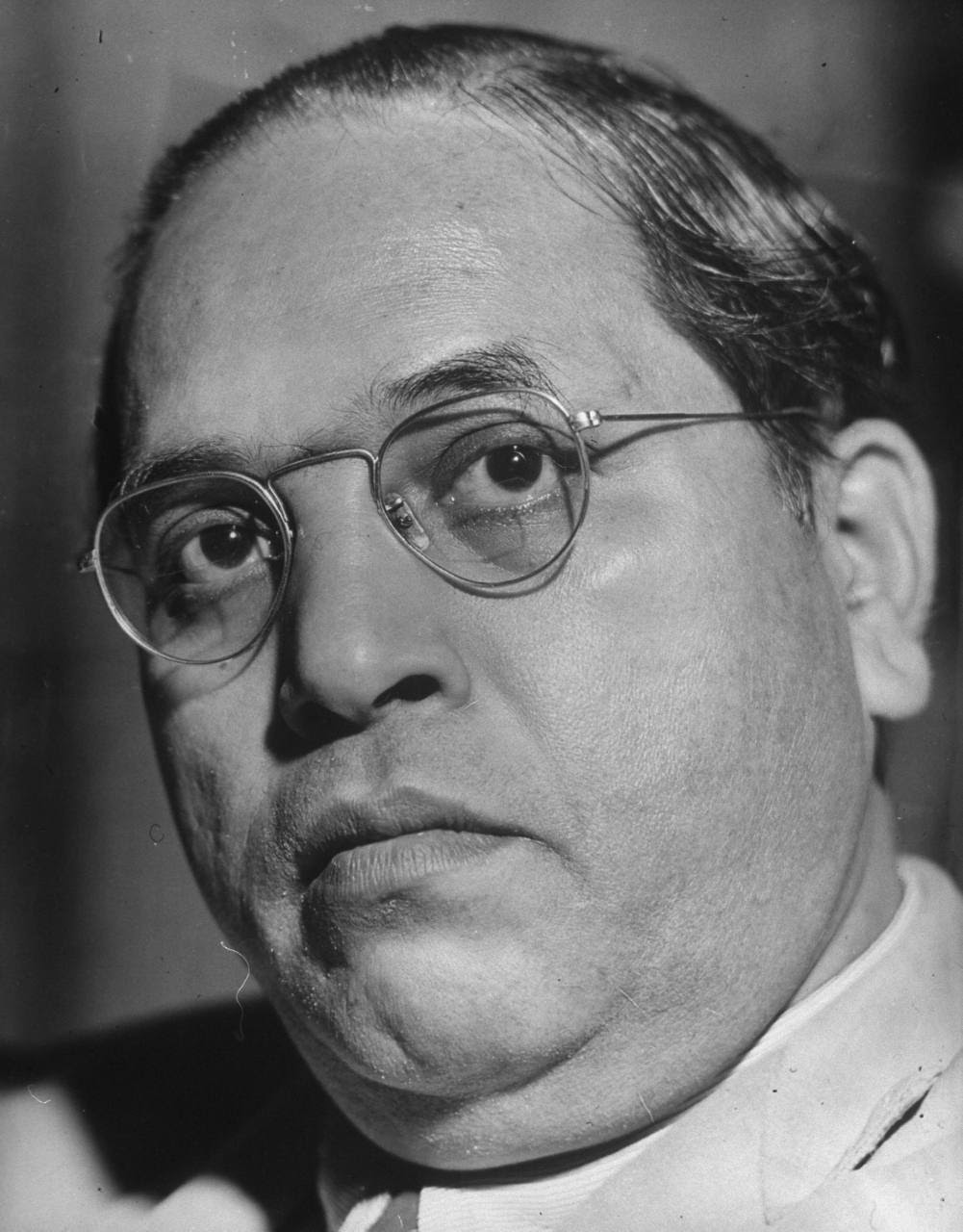
Ambedkar demonstrated that the dominant classes intentionally maintain and enforce the concept of "pollution" and social outcasts. The existence of an marginalized layer is the ultimate stabilizer for the rest of the pyramid. It provides an absolute bottom.
For the classes above, knowing that someone else is permanently relegated to the base of existence satisfies a primitive anxiety: no matter how precarious their own lives feel, they are not at the bottom. The system manufactures a class of people deemed inherently broken to guarantee a permanent sense of relative security for everyone else.
The Pathologization of Dissent: Defining the "Insane"
The intersection between mental health and social structures operates on a identical axis. When an individual collapses under the weight of a toxic environment, family, or workplace, the structure’s immediate reflex is to pathologize the individual rather than audit itself.
In Madness and Civilization, Michel Foucault traced how "mental illness" has historically been constructed as a social category rather than a purely biological reality. Foucault argued that society uses the asylum and the clinical label to isolate and silence those who do not or cannot conform to the rigid demands of production and social order.
Dimension | The Medical Model | The Structural Model (Foucault/Fanon) |
The Root Cause | Internal chemical imbalance or personal vulnerability. | A normal reaction to an inherently toxic or oppressive environment. |
The Group's Goal | To treat and cure the individual in isolation. | To label the individual as "broken" to protect the system from critique. |
The Outcome | The individual is medicated or adjusted back to the norm. | The status quo remains unquestioned; the group feels vindicated. |
When a person is labeled "mentally damaged" by a group, it acts as an effective shield against accountability. If the individual is crazy, their complaints are invalid, their pain is irrational, and the group's behavior remains completely absolved.
As the revolutionary psychiatrist Frantz Fanon noted in The Wretched of the Earth, what looks like psychological breakdown is often the inevitable, predictable result of living within an oppressive, high-pressure system. The tragedy is that the system treats the victim's breakdown as proof of their inherent weakness, rather than proof of the system's cruelty.
The Zero-Sum Reflex: Panic at the Waterfall
The primal image of individuals in a crisis such as a sudden, terrifying physical struggle like a drowning event, or the intense, claustrophobic pressure of an elite academic environment reveals how quickly human behavior can strip down to a zero-sum calculation. When the environment signals that resources, space, or survival are drastically limited, the cooperative veneer vanishes.
This panic mimics the darker misinterpretations of Darwinism popularized by Herbert Spencer, who coined "survival of the fittest" to justify social exploitation. Spencer claimed that life is a brutal, natural sorting mechanism where the weak are meant to sink so the strong can rise.
However, thinkers like Peter Kropotkin strongly countered this framework in Mutual Aid. Kropotkin observed that in social species, survival is driven by cooperation, not dog-eat-dog competition.
"Practicing mutual aid is the surest means for giving each and all the greatest safety, the best guarantee of existence and progress." - Peter Kropotkin
Yet, when a social structure is designed around artificial scarcity whether it is a hyper-competitive corporate ladder, an elite B-school grade curve, or a rigid class hierarchy it forces individuals to operate inside Spencer’s flawed framework. It creates an environment where people feel that to stay afloat, they must physically or metaphorically place their weight on someone else’s shoulders.
Turning the Lens Inward
To break out of this cycle, we have to stop looking exclusively at the person who is breaking down and start looking at the architecture of the room they are standing in.
Whenever you encounter a social circle, a corporate team, or an extended family that points to one person as the permanently "fucked up" outlier, ask the systemic question:
What does this person's failure buy for the rest of the group? What anxieties are they absorbing so that everyone else can sleep at night?
Recognizing this dynamic is deeply uncomfortable because it forces us to confront our own complicity. It asks us to admit that we have, at times, accepted the comfort of being the "sane" one, the "successful" one, or the "normal" one simply because we stood silently while the group designated a scapegoat to sink to the bottom. But seeing the mechanism clearly is the only way to stop using other human beings as anchors for our own stability.
Liked this story?
Discover more voices from the Dalit storytelling archive, reflections, struggles, and steps to transform our future.
Browse all storiesPass it forward
Know someone who needs stories like this? Bring them into the movement through our Referral Circle.
 Join the Referral Circle