
Reorienting IIM Kozhikode: From Arjuna’s Myth to Ambedkar’s Ideal
Executive Summary
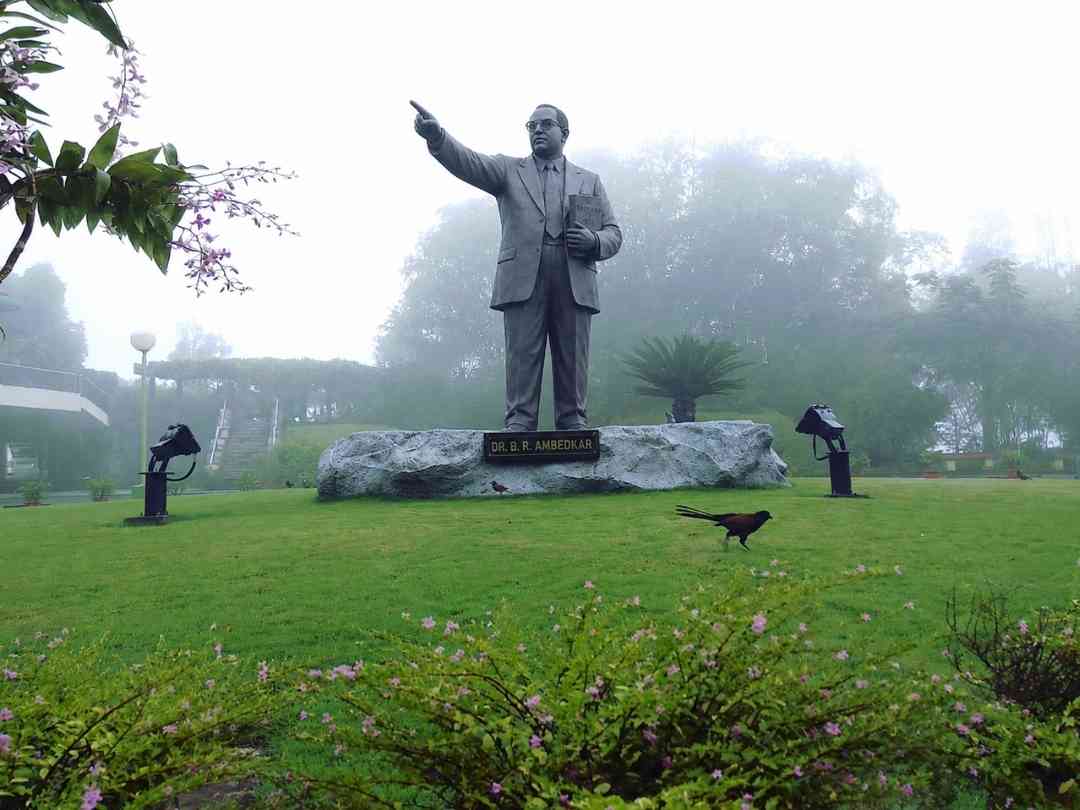
IIM Kozhikode’s stated vision is “Globalizing Indian Thought by Inculcating Authenticity, Sustainability and Fulfillment,” and its mission emphasizes wholesome learning to nurture socially responsible leaders. The institute currently features a statue of the mythological archer Arjuna, symbolizing focus, clarity of vision, resilience, and leadership. A shift to associating the institute’s symbol with Dr B.R. Ambedkar – a modern icon of equality and justice – could realign its ethos toward social equity and constitutional values. Ambedkar’s educational ideals (e.g. equality, social justice, meritocracy, scientific temper, and rule of law) are well documented. Adopting an Ambedkar-inspired identity might entail more inclusive governance, outreach to marginalized communities, and a curriculum stressing critical inquiry, ethics, and constitutional values.
Indian universities underperform in global rankings (THE, QS, ARWU) largely due to low research impact, limited internationalization, rigid governance, underfunding, and equity gaps. For example, only a handful of IITs/IISc appear (IIT Delhi 118 in QS) and none in the world top 100. Rankings methodologies confirm these biases: QS weights academic/employer reputation and citations heavily; THE weighs teaching, research and international outlook; ARWU focuses on Nobel laureates and research output. India’s public R&D spending remains under 1% of GDP, and higher-education funding ~3–4% of GDP (below global norms), reflecting resource constraints.
To improve, evidence-based reforms are needed: greater research funding and incentives, autonomy for universities, faculty development, industry and international partnerships, and stronger equity measures. An Ambedkar-inspired approach reinforces this agenda: for instance, expanding access for disadvantaged groups, integrating social justice in the curriculum, and fostering campus culture of inclusivity and critical debate. Actionable steps – such as revising admissions and governance policies and enhancing outreach and research – are summarized below, with a proposed implementation timeline. This comprehensive strategy aligns Ambedkar’s principles with global excellence goals, aiming to elevate IIM Kozhikode and similar institutions on the world stage.
IIM Kozhikode: Mission, Vision and Symbolic Heritage
IIM Kozhikode’s official vision is: “Globalizing Indian Thought by Inculcating Authenticity (Satyam), Sustainability (Nityam) and Fulfillment (Purnam)”. Its mission emphasizes creating a “unique space of global reckoning” and “nurturing capable and dependable management thinkers” who are “socially responsible” and “environmentally friendly”. These statements highlight values of ethical leadership, social responsibility, and a blend of Indian philosophy with global outlook.
The institute’s campus features a prominent Arjuna statue, reflecting its current symbolic identity. Arjuna, the legendary archer of the Mahabharata, is interpreted as embodying “Focus and Clarity of Vision,” “Resilience,” and “Leadership in Action”. For example, texts note that Arjuna “could see only the bird’s eye while practising archery,” teaching leaders to cut through distractions. This symbolizes striving for excellence and purposeful leadership. However, relying on a mythic figure as the emblem ties the institute’s identity to traditional warrior ideals. By contrast, an Ambedkar statue would foreground constitutionalism and social reform. (The exact context or location of the Arjuna statue is not officially documented, but it is widely noted as a campus landmark inspiring students.)
Ambedkar’s Educational Principles in Higher Education
Dr. B.R. Ambedkar’s writings and speeches championed equality, social justice, and rational inquiry as cornerstones of education. His educational philosophy was “rooted in the principles of liberty, equality, and fraternity,” aiming to “uplift the oppressed and eradicate caste-based discrimination” through learning. He insisted that schools inculcate values of “liberty, equality, fraternity, justice and moral character” in students of “all religion, region, class and caste”. Ambedkar vehemently opposed any form of discrimination in education, arguing that access should be a fundamental right for every individual regardless of caste, gender or economics. For him, education was the “most powerful weapon to liberate marginalized communities”, and he coined the motto “Educate, Agitate, Organize” to emphasize learning plus social action.
He also advocated meritocracy combined with affirmative inclusion. Ambedkar established model institutions via the People’s Education Society and declared that teachers must be hired “irrespective of caste,” prioritizing highest qualifications, even while ensuring Dalit students could enroll. He supported free, universal, secular education, and science-based curricula free of superstition. In sum, Ambedkar’s vision for higher education encompassed: equality of opportunity (social justice); rigorous, critical inquiry (scientific temper and constitutionalism); institutional design that is democratic and merit-based; and the empowerment of disadvantaged groups. These principles suggest a campus culture that actively promotes diversity, challenges entrenched hierarchies, and links education to broader social reform.
Comparative Dimensions: Mythological vs. Ambedkarian Identity
| Dimension | Mythology/Arjuna Symbol | Ambedkar-Inspired Vision |
| Governance | Top-down leadership emphasis; hierarchy of discipline and discipline (echoing warrior command). | Participatory, transparent governance; stronger emphasis on social justice and representation (e.g. seats for marginalized; bodies for diversity). |
| Admissions | Merit-focused cohort (as is usual), with prestige bias; possibly less attention to social quotas beyond statutory reservations. | Robust affirmative measures beyond quotas (economic as well as caste), outreach to underrepresented groups, ensuring true equity in selection. |
| Curriculum | Traditional management curriculum with case studies of business/principles, perhaps occasional mythological inspiration (like leadership from epics). | Broadened curriculum including social entrepreneurship, ethics, constitutional law, poverty/social inequality, critical thinking – reflecting Ambedkar’s emphasis on social change and democracy. |
| Research Priorities | Focus on core management, technology, and leadership innovation; excellence metrics (profits, efficiency). | Increased research on social justice, inclusive development, public policy, sustainability, and interdisciplinary themes (aligning with Ambedkar’s social transformation goals). |
| Outreach & Engagement | Industry tie-ups, corporate internships, global case competitions. | Active community engagement (rural development, literacy, social campaigns), collaboration with NGOs/government on inclusive growth – reflecting Ambedkar’s grassroots ethos. |
| Campus Culture | Emphasis on excellence, competitiveness, and personal discipline (as symbolized by Arjuna’s focus). | Culture of inclusivity, open debate on social issues, anti-discrimination efforts; celebration of Ambedkar Jayanti, seminars on constitutional values, mentoring for disadvantaged students. |
| Public Engagement | Speeches and events featuring business/tech leaders; branding around “visionary leader” imagery. | Public talks and programs on social justice, human rights, law; partnerships with government initiatives (e.g. literacy, reservations awareness), advocacy for educational equity. |
| Success Metrics | Placement rates, starting salaries, entrepreneurial ventures, traditional rankings (research, reputation). | Expanded metrics including diversity indices, social impact (villages uplifted, policy changes informed by campus research), contributions to equity – in addition to conventional rankings. |
Global Rankings and India’s Performance
Leading ranking systems differ markedly in criteria. Times Higher Education (THE) uses five pillars: Teaching (29.5%), Research (29%), Citations (30%), International Outlook (7.5%), Industry Income (4%). QS assigns 30% weight to academic reputation, 20% to citations/faculty, 15% to employer reputation, 10% to faculty-student ratio, and 15% total to international metrics. ARWU (Shanghai Ranking) focuses almost entirely on research excellence: Nobel/Fields prizes (alumni 10%, staff 20%), Highly Cited Researchers (20%), publications in Nature/Science (20%), other WoS-indexed papers (20%), and per-capita performance (10%). In short, these systems reward high-impact research, global reputation, and internationalization, often more than teaching quality or societal impact.
India’s institutions have improved presence but still lag in rank. As of 2026, QS counted 52 Indian universities (up from 14 in 2015) – the fastest growth among major countries. The top QS ranks are IIT Delhi (now ~118th globally) and IIT Bombay (134th). THE reported only two Indian entries within the top 400 (IISc Bengaluru and a private medical institute). Notably noIndian university is in the world top 100 across major lists. Performance gaps remain wide: Indian scores in research output, citation impact, international faculty/students, and global reputation are far below Western leaders. In the QS Subject and THE thematic rankings, however, some fields (e.g. engineering, computer science) have seen gains due to targeted research funding.
Structural Barriers in Indian Higher Education
Several entrenched barriers hinder global competitiveness. Underfunding: India’s R&D spend is under 1% of GDP (one of the lowest in the G20), and government education expenditure is only ~4–5% of GDP. Many institutions lack adequate labs, libraries, and research grants. Rigid Governance: State and central regulations often constrain autonomy. Public universities must follow UGC/AICTE norms on curricula and hiring, limiting innovation. Hiring and promotion procedures are bureaucratic, with relatively low faculty-to-student ratios (limiting THE teaching score). Faculty and Research: Indian academia has fewer PhD holders and senior researchers per capita. High-impact publications and global collaborations are still scarce. Internationalization: Visa hurdles and low brand recognition result in few international students/faculty. The government’s internationalization indices remain low, putting downward pressure on QS international metrics. Language and Networks: While instruction is often in English, local-language focus in research can limit global citations. Conversely, cultural biases in rankings (favoring Anglo-American institutions) can disadvantage Indian universities despite improvements.
Moreover, equity and inclusion challenges persist. Many campuses still struggle with caste-based segregation and gender gaps. Ambedkar himself noted that mainstream institutions were dominated by upper castes, hindering truly meritocratic education. These social divisions can erode the collaborative, merit-driven culture valued by rankings. External factors – such as less mature industry–academia linkage and lower private endowments – also play a role. In summary, Indian universities often score poorly on the research output, citation per faculty, and international collaboration indicators that drive QS and ARWU rankings, as well as on THE’s reputation and international outlook pillars.
Recommendations for Reform
Drawing on Ambedkar’s ideals and global best practices, the following evidence-based reforms are recommended:
Increase Funding and Autonomy: Substantially raise public R&D and higher-education budgets (aiming toward 2% of GDP) and allow institutions to retain and redirect more resources. Offer competitive research grants and tax incentives for industry collaboration. Devolve hiring and academic decisions to universities (while ensuring accountability), enabling merit-based faculty recruitment and curricular innovation.
Strengthen Research and Innovation: Incentivize high-quality research through grants tied to international publication and patent output. Encourage interdisciplinary projects on national priorities (AI, clean energy, public health). Expand post-graduate and PhD programs, and create Centers of Excellence with global partnerships. Promote publications in indexed journals and participation in international conferences.
Internationalization and Collaboration: Actively recruit foreign faculty and students by easing visa procedures, offering scholarships, and establishing global joint degree programs. Fund faculty exchanges and joint research labs with top universities. Build strong alumni networks abroad to aid recruitment and fundraising. Learn from Asian neighbors’ initiatives (e.g. Singapore’s campus model, China’s huge research funding).
Equity and Outreach: Deepen affirmative action beyond existing quotas, including economic and regional diversity. Establish bridge/prep courses and scholarships for underprivileged groups to thrive in management programs. Celebrate Ambedkar’s legacy on campus to sensitize students to social justice (e.g. seminars, lecture series on constitution, leadership with values). Link outreach activities (rural development projects, education drives) to curriculum, reflecting Ambedkar’s emphasis on social transformation through education.
Quality Teaching and Curriculum Reform: Invest in continuous faculty development, pedagogy workshops, and modern teaching aids. Reduce student–faculty ratios and emphasize experiential, interdisciplinary learning. Revise curriculum to include ethics, constitutional law, diversity and inclusion case studies, and critical thinking components (in line with Ambedkar’s secular scientific emphasis). Encourage humanities and social science research alongside core management to produce well-rounded leaders.
Governance Innovation: Adopt multi-stakeholder governance bodies (including alumni, faculty, student, and external experts) to mirror democratic accountability. Implement transparent performance metrics (aligned with Ambedkar’s meritocratic standards) and peer review of leadership. Allow institutional differentiation: some IIMK-like schools may focus on research and others on teaching excellence, as suggested by experts.
The implementation timeline below outlines phased actions over the next 3–5 years:
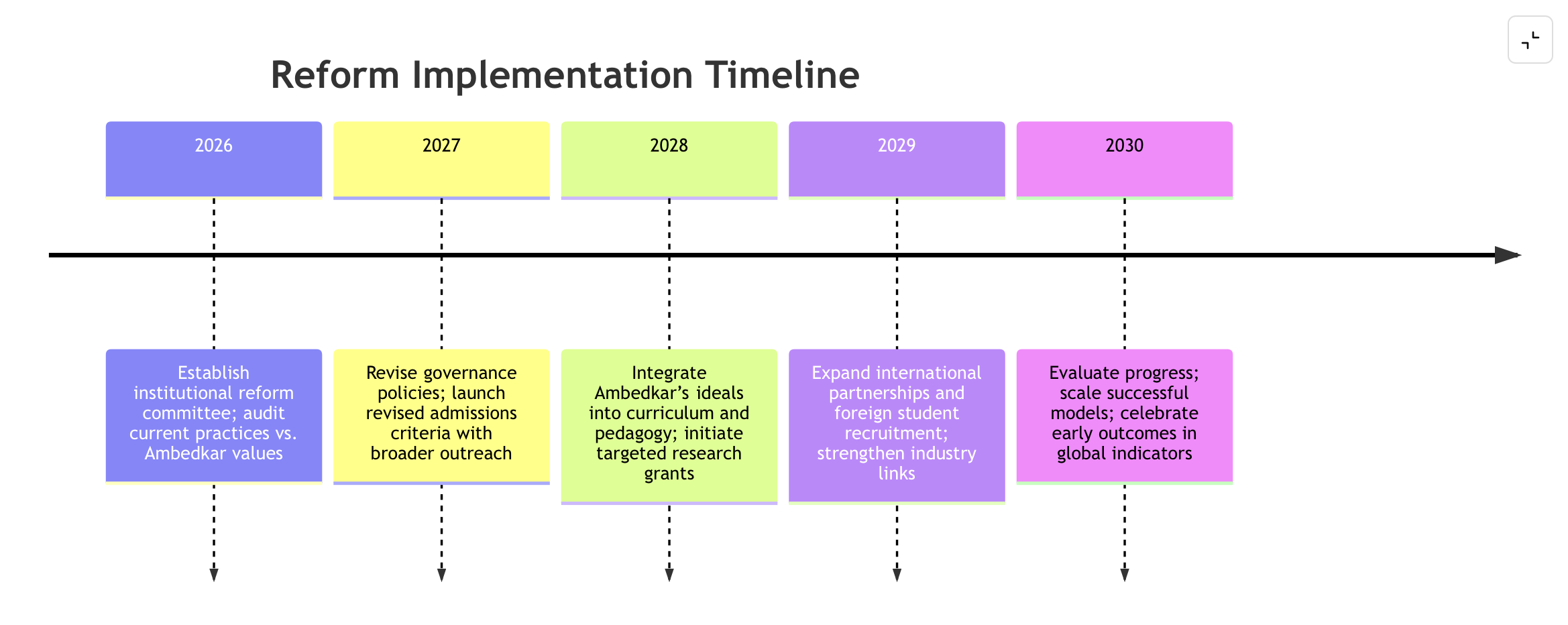
Timeline These steps are grounded in research that calls for increased funding, global collaborations, and faculty/student diversification. For IIM Kozhikode specifically, forming an Ambedkar Steering Group in 2026 could guide these reforms – for example, instituting a committee to redesign orientation programs around Ambedkar’s legacy, or to negotiate new funded chairs in social entrepreneurship.
Conclusion
Aligning IIM Kozhikode’s symbolic identity with Dr. Ambedkar’s legacy has the potential to transform its culture and impact. Ambedkar’s principles of equality, justice, critical inquiry, and constitutionalism complement efforts to raise academic excellence and global standing. By embedding these values into governance, teaching, research, and outreach, IIM Kozhikode (and similar Indian institutions) can address the systemic barriers identified above. This dual focus – pursuing global excellence and deepening social equity – echoes Ambedkar’s own vision of education as a catalyst for a better, more just society. Ultimately, a commitment to both satya (truth in learning) and dharma (ethical duty) will serve IIM Kozhikode’s mission to educate leaders who not only excel in business, but also contribute to creating a fairer world.
Liked this story?
Discover more voices from the Dalit storytelling archive, reflections, struggles, and steps to transform our future.
Browse all storiesPass it forward
Know someone who needs stories like this? Bring them into the movement through our Referral Circle.
 Join the Referral Circle