
Mahavir Said Conduct. Jains Chose Birth. How Brahminism Won Inside Jainism.
The distance
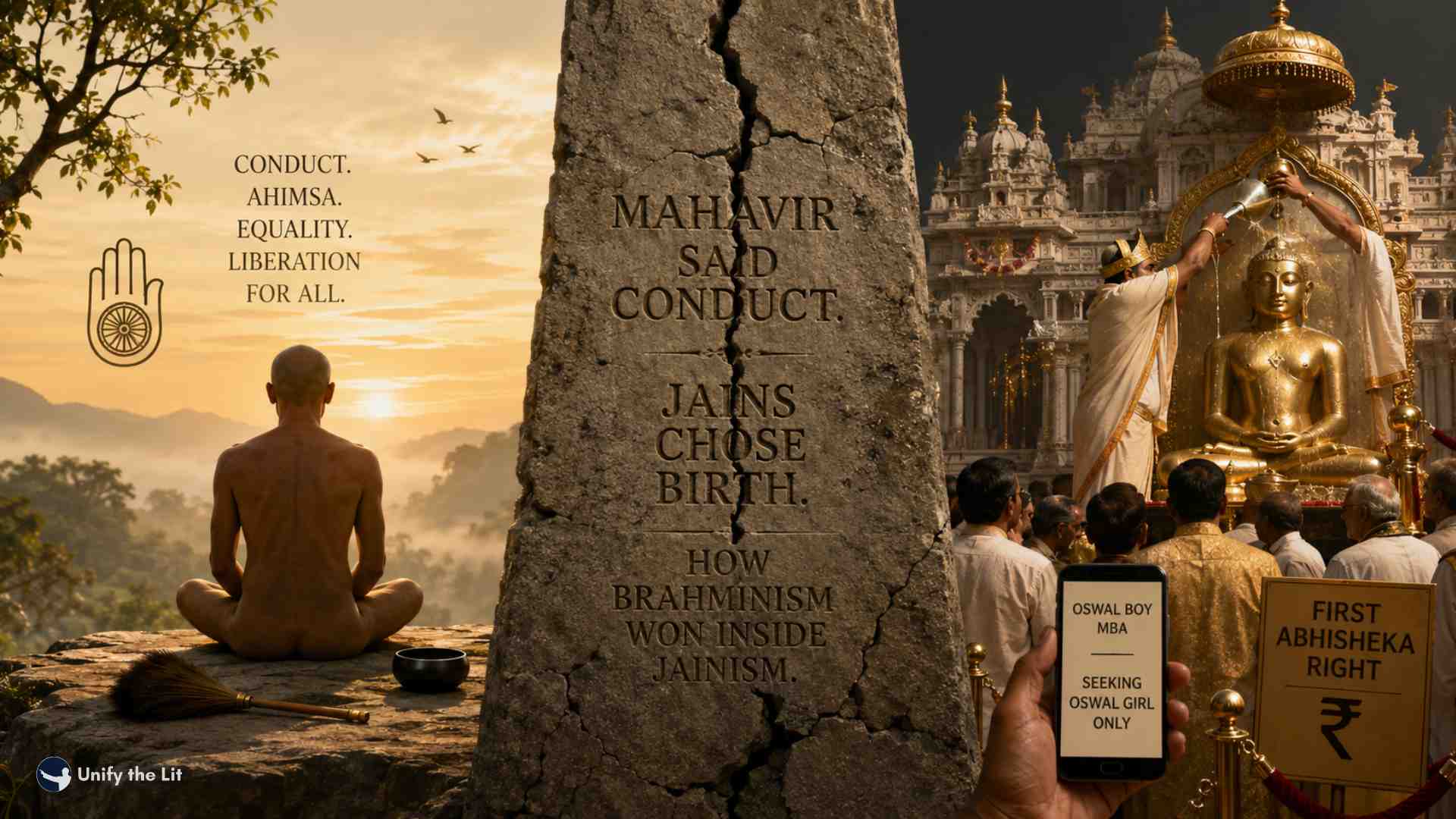
Walk into a large Jain temple on a festival morning. Marble imported and polished. Gold leaf. A bidding war for the right to perform the first abhisheka, the price announced aloud. A pujari often not a Jain reciting on your behalf. Outside, in the community WhatsApp group, a matrimonial post: Oswal boy, MBA, seeking Oswal girl only.
Now open the Uttaradhyayana Sutra and meet the man this temple claims to honour: a naked ascetic who owned nothing, performed no ritual, employed no priest, and told a Brahmin sacrificer to his face that his sacrifices were worthless.
The distance between those two scenes is the subject of this article. It is not a small drift. On the specific questions of birth, priesthood, ritual and hierarchy, Jain practice today holds close to the exact position Mahavir spent his life attacking.
This is not an outsider's accusation. Every claim below is sourced to the Jain canon, to Jain scholars, or to the Government of India. Check them.
What Mahavir actually said
Chapter 25 of the Uttaradhyayana Sutra "The True Sacrifice" stages a confrontation at Benares between the Jain monk Jayaghosa and the Brahmin sacrificer Vijayaghosa. The monk dismantles him. Hermann Jacobi's translation (Sacred Books of the East, vol. 45) gives the verses plainly:
"The binding of animals, all the Vedas, and sacrifices, being causes of sin, cannot save the sinner; for his works are very powerful." (25.30)
"One does not become a Sramana by the tonsure, nor a Brahmana by the sacred syllable om, nor a Muni by living in the woods, nor a Tapasa by wearing clothes of Kusa-grass and bark." (25.31)
"By one's actions one becomes a Brahmana, or a Kshattriya, or a Vaisya, or a Sudra." (25.33)
Read 25.33 again. That single line dissolves the entire architecture of varna. Caste is not a birth-status conferred by cosmic order; it is a description of what you do. It can be earned and it can be lost, within one life.
And this is not an isolated verse. Chapter 12 of the same text tells the story of Harikesha-Bala, a monk "born in a family of Svapakas" a Chandala, an outcaste. He approaches a Brahmanical sacrifice for alms. The priests, described by the text as "stuck up by pride of birth, those killers of animals, who did not subdue their senses, the unchaste sinners," drive him away as a dirty man. The text vindicates him and humiliates them.
The Jain canon contains a story in which an outcaste monk is morally superior to the entire Brahmin priesthood, and the priesthood is called out by name for pride of birth. It is right there. Most Jains have never read it.
The Acaranga Sutra, the oldest text in the canon, completes the picture. Its concern is ascetic conduct: non-injury, non-possession, restraint, inner discipline. "All beings are fond of life, like pleasure, hate pain, shun destruction, like life, long to live. To all life is dear." There is no creator god to appease, no priest to mediate, no ritual to purchase. There is only what you do and what it does to your soul.
No god. No priesthood. No Vedic authority. No birth-status. Liberation open to anyone who does the work. That is the doctrine.
The year it turned
So how did a religion with no theological room for caste end up as a set of endogamous trading castes? We can name the moment with unusual precision. In the ninth century CE, Jinasena a Digambara acharya and rajaguru to the Rashtrakuta emperor Amoghavarsha wrote the Adipurana.
Jinasena did something no earlier Jain had done: he built Jainism a varna system of its own. He could not borrow the Purusha Sukta, so he invented a Jain origin myth in which Bharata, son of Rishabha, sorts men by an ahimsa-test and names the ones who refuse to harm as the priestly varna the dvija, the twice-born, the deva-Brahmanas. He supplied Jain samskaras. He gave Jainism a Manu.
Padmanabh Jaini, the most eminent modern scholar of Jainism, records the outcome without flinching in The Jaina Path of Purification. The Adipurana insists there is only one jati, the human jati, with divisions arising from occupation and yet the "Jaina-brahman" caste it created "eventually developed into a caste nearly as rigid as its Hindu counterpart; membership became strictly hereditary." Jaini's conclusion: "Thus the Jainas converted the varna system into what was for them an acceptable form."
Paul Dundas, in The Jains, puts the present tense on it: "While Jainism has rejected the traditional brahman idea of society being structured around purity and impurity, castes do nonetheless exist as a significant component within the Jain community."
A doctrine of conduct was quietly refitted with a hierarchy of birth. Not by Brahmins. By Jains, for Jains, in a Jain text, under royal patronage.
What the numbers say now
Doctrine is arguable. Data is not.
The 2011 Census religious data gives Jains the highest literacy rate of any community in India 94.9%. It also gives Jains a child sex ratio of 889 girls per 1,000 boys in the 0–6 age group. The national figure is 918. Muslims: 943. Christians: 958. Only Sikhs are worse.
Hold those two numbers together. The most educated community in India is among the worst at letting its daughters be born. That is not a Jain teaching. Mahavir did not teach son-preference. That is Brahminical patriarchy, ingested whole, and the honest note is that the figure has improved it was 870 in 2001 which only proves the community can move when it decides to.
Jati endogamy is the second exhibit. Oswal, Porwal, Shrimal, Khandelwal, Agrawal. Documented by John Cort, Marcus Banks and Vilas Sangave as the functioning unit of Jain social life, enforced historically by caste panchayats and today by the matrimonial column. Sect is negotiable. Jati is not. This is precisely the birth-status that Uttaradhyayana 25.33 abolished.
And the political alignment. When the Vishwa Hindu Parishad was founded in Mumbai in 1964 at a meeting convened under RSS chief M.S. Golwalkar, the Jain monk Sushil Muni was in the room. The Supreme Court in Bal Patil (2005) observed that "Jainism is a special religion formed on the basis of quintessence of Hindu religion." Savarkar's Hindutva absorbs Jains by definition. Large parts of the community have not merely accepted that absorption they have funded it.
A tradition founded on the rejection of Vedic authority now supplies money and moral cover to its most aggressive modern defenders. Mahavir argued with those men. His followers donate to them.
Three objections, taken seriously
A Jain scholar reading this will reach for three counter-arguments. All three are legitimate. None of them saves the practice.
First: the Kalpa Sutra records that Mahavir was conceived in the womb of the Brahmin woman Devananda and transferred by divine intervention to the kshatriya queen Trishala, because Tirthankaras are never born in "low" families. Jaini reads this as straightforwardly kshatriya-supremacist. It is. Early Jainism inverted the Brahmanical hierarchy rather than abolishing it. Conceded. But note what an inversion is not: it is not a defence of the Brahmin ritual order that Jains today finance. And note that the Digambaras reject the story entirely.
Second: Mahavir's eleven ganadharas his chief disciples were all Brahmins by birth. True. They were also Vedic scholars he argued out of Vedic religion. That is a fact about who he converted, not about what he taught.
Third: image worship in Jainism is ancient, attested at Mathura around the turn of the first millennium. It is not a medieval invention. Also true, and the argument here was never that a Jain must not bow before a murti. The argument is about dominance and proportion: when the ritual economy of the temple becomes the centre of religious life and meditation becomes an optional extra, the tradition has inverted itself. Mahavir attained kevalya sitting in dhyana, not sponsoring a puja.
Ambedkar already diagnosed this
In Annihilation of Caste (1936), Dr. Ambedkar wrote one line about Jainism that ought to be read aloud in every derasar:
"That is the reason why Brahmanism has so much more hatred and antagonism against Buddhism than it has against Jainism."
Read what he is saying. Brahminism did not fight Jainism as it fought Buddhism, because Jainism never pressed the fight. The Buddha attacked birth-based varna directly and by name. Jainism kept its metaphysics and let the social order stand. Buddhism was destroyed in India. Jainism survived and the price of survival was caste.
Ambedkar's central argument applies with full force here: "Caste is the natural outcome of certain religious beliefs which have the sanction of the shastras." And his remedy: "You must not only discard the shastras, you must deny their authority."
Jains do not need to discard their shastras. That is the whole point. Their shastras are on their side. What Jains must deny is the authority of Jinasena, and of every accretion that came after him.
The repair is already Jain
This is not a call to import someone else's reformation. Jainism has argued with itself, correctly, for six hundred years and lost the argument every time only because the laity stopped listening.
In the fifteenth century, Lonka Shah a scribe in Gujarat who actually read the scriptures he was copying concluded that temple worship had no canonical sanction and that image-making itself violated ahimsa. From him came the Sthanakavasi, who worship in a plain hall with no idol at all. In 1760, Acharya Bhikshu founded the Svetambara Terapanth on the same rejection. In 1949, Acharya Tulsi launched the Anuvrat movement. And in 1975, Acharya Mahaprajna formalised Preksha Dhyana reconstructing Jain meditation directly from the Acaranga and Sutrakritanga, because the living tradition had let it die.
Sit with that last fact. A Jain acharya, fifty years ago, had to rebuild Jain meditation from the texts, because Jains had stopped doing it. The temples were full. The dhyana was extinct.
So here is the work, and none of it requires permission from anyone:
Read the Uttaradhyayana. Chapter 12 and Chapter 25. Not a discourse about it the text. It takes an evening.
Move the centre of your practice from the temple to the mat. Samayika, kayotsarga, preksha. Mahavir's method was meditation. The abhisheka bidding is not his method; it is an auction.
Break the jati line. The single most Jain thing a Jain family can do in 2026 is let their child marry outside the caste, because Uttaradhyayana 25.33 says the caste was never real.
Audit what your temple trust spends. Gold leaf, or education for the people your community has excluded for a thousand years. Ahimsa that extends to insects but not to Dalits is not ahimsa. It is fastidiousness.
Stop funding Brahminism. Know whose platform you are standing on.
Mahavir did not found a caste. He did not found a temple economy. He walked away from a kingdom, wore nothing, and told a Brahmin priest to his face that birth confers nothing and conduct confers everything.
You do not need a new religion. You need your own.
Liked this story?
Discover more voices from the Dalit storytelling archive, reflections, struggles, and steps to transform our future.
Browse all storiesPass it forward
Know someone who needs stories like this? Bring them into the movement through our Referral Circle.
 Join the Referral Circle