
Ambedkar on Pushyamitra: The Brahmin Counter-Revolution
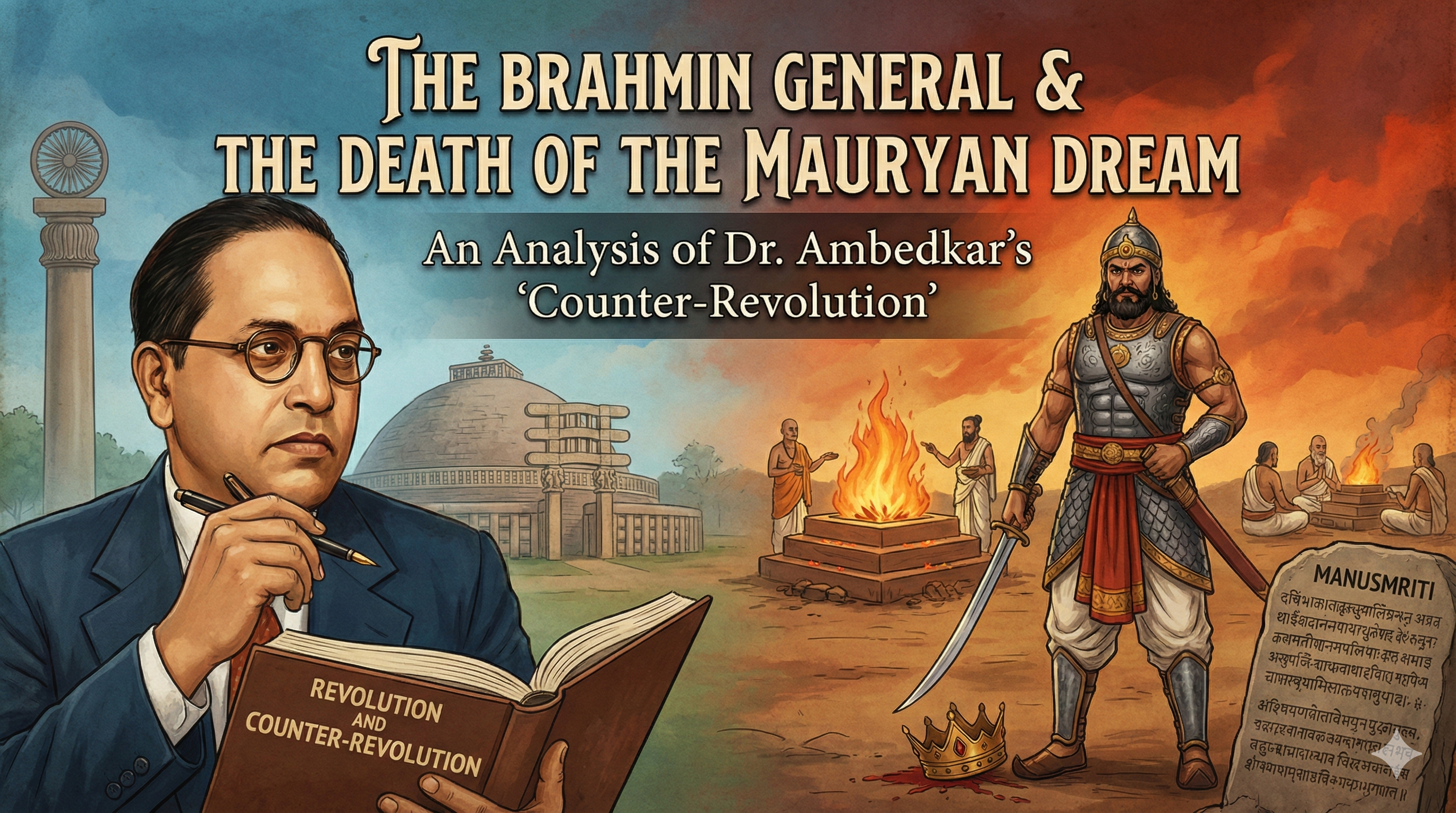
The Context: India Before the Shungas
To understand the gravity of Pushyamitra’s actions, we must first look at what existed before him. Under the Mauryan Emperors, specifically Ashoka and his descendants, India was undergoing a massive social transformation.
Dr. Ambedkar describes this period as one where the "Brahmin" had lost his supreme status. He was no longer above the law. This loss of privilege created a simmering resentment. The Mauryan Empire was a state based on the Buddhist principles of equality, which stood in direct contradiction to the graded inequality favored by orthodox Brahminism.
The stage was set for a reaction. The priestly class was waiting for an opportunity to reclaim their lost authority. That opportunity arrived in the form of Pushyamitra Shunga.
The Regicide: A Military Coup or a Religious Revolution?
Pushyamitra was the Commander-in-Chief (Senapati) of the Mauryan Army. He served the last Mauryan King, Brihadratha.
In his work Revolution and Counter-Revolution in Ancient India, Dr. Ambedkar describes the event vividly:
"Pushyamitra was a Samavedi Brahmin. He was the commander-in-chief of Brihadratha, the last Mauryan King.
Dr. Ambedkar is highlighting a profound contradiction here. In the traditional hierarchy of the "Varna" system, a Brahmin is supposed to be a custodian of knowledge, peace, and spirituality.
This brings us to the core question of "Caste vs. Quality." If a person born as a Brahmin commits the ultimate act of violence and treachery, does he remain a Brahmin? Under the rational view, he acts as a warrior or a criminal. But in the eyes of the orthodox counter-revolutionaries, his birth defined him, not his actions. He was celebrated not for his adherence to non-violence, but for destroying the Buddhist rule that threatened Brahminical dominance.
Dr. Ambedkar further elaborates on the nature of this betrayal:
"The aim of the Regicide was to destroy Buddhism and re-establish Brahmanism. This is clear from the facts of history. The first victim of Brahmanism was the head of the State. It was a political revolution caused by a religious motive."
For the common person, this means that Pushyamitra did not kill the King because the King was a bad ruler or because the economy was failing. He killed the King because the King was a patron of Buddhism. The state machinery was being used to promote equality, which the orthodox groups found intolerable. The "Revolution" was the murder of the state itself to change the religion of the land.
The Three Pillars of the Counter-Revolution
Once Pushyamitra took the throne (circa 185 BCE), he did not just sit back and rule. He initiated a series of radical changes that Dr. Ambedkar identifies as the pillars of the Counter-Revolution. These actions fundamentally altered the social fabric of India.
1. The Revival of Animal Sacrifice
Under Ashoka and the Mauryans, animal sacrifice had been banned.
Dr. Ambedkar notes:
"Pushyamitra celebrated his accession to the throne by the performance of the Ashvamedha Yajna... It was a proclamation to the world that Brahmanism had come back to its own."
By performing the Ashvamedha Yajna (Horse Sacrifice), Pushyamitra was sending a signal.
2. The Persecution of Buddhism
The second pillar was the systematic dismantling of the Buddhist sangha. Since Buddhism was the religion that preached equality, it had to be suppressed for inequality to thrive again.
Dr. Ambedkar cites historical texts to reveal the extent of this persecution:
"Pushyamitra set a price of 100 gold pieces on the head of every Buddhist monk."
This is a chilling detail. It wasn't just a lack of funding; it was an active hunt. Monasteries were destroyed, and monks were killed. This created a climate of fear. For the common people, the message was clear: the path of equality and rationality was now dangerous. To survive, one had to submit to the new authority.
3. The Codification of Inequality: The Manusmriti
Perhaps the most damaging and long-lasting legacy of the Pushyamitra era, according to Dr. Ambedkar, was the creation of the Manusmriti.
Dr. Ambedkar argues that the Manusmriti was not an ancient text from the dawn of time, but a code of laws written specifically during the Shunga period to cement the Counter-Revolution. The Mauryan laws were secular and equal; the Shungas needed a new legal framework to justify their coup and the new social order.
Dr. Ambedkar writes:
"The Manusmriti is a record of the social and political changes that were brought about by the Pushyamitra regime... It is the Bible of the Counter-Revolution."
This is the most critical point for understanding the "Caste vs. Quality" debate. Before this period, there was some fluidity in society. But the laws codified under the Shunga influence (attributed to Manu) froze society into rigid compartments.
The Manusmriti declared that a Brahmin, by virtue of his birth alone, was the lord of all creation. It established that:
If a Shudra insults a Brahmin, his tongue should be cut out.
If a Brahmin kills, he cannot be executed, only banished (at worst).
A Brahmin could act as a warrior (like Pushyamitra) or a merchant, but a Shudra could never act as a priest.
This completely divorced "Quality" from "Caste." Pushyamitra proved that a Brahmin could be a violent murderer and a king. Yet, the laws created under his regime stated that such a person was still worship-worthy, while a virtuous person of lower birth was to be despised. The "Guna" (virtue/quality) was replaced entirely by "Janma" (birth).
The Philosophical Implications: The Fall of Merit
The user asked a profound question: Do people calling themselves Brahmin even have the qualities of Brahmins?
Dr. Ambedkar’s analysis of Pushyamitra provides the historical answer. The rise of the Shunga dynasty marked the moment when "Brahminism" stopped being about spiritual quality and became a political ideology of power.
If we look at the definition of a Brahmin in early spiritual texts, it denotes a person of renunciation, non-violence, and truth. Pushyamitra violated all three:
1. Renunciation: He usurped a throne and craved power.
2. Non-violence: He committed regicide and persecuted monks.
3. Truth: He betrayed the oath of loyalty he swore to his King.
Yet, under the system he established, he was the savior of Dharma. Dr. Ambedkar points out this hypocrisy to show that the caste system is not based on merit or conduct.
Dr. Ambedkar sums up the result of this transition:
"Established in the reign of Pushyamitra, Brahmanism became the very negation of the spirit of Liberty, Equality and Fraternity."
The "Counter-Revolution" was successful. It destroyed the egalitarian progress made by the Mauryas. It replaced the "Rule of Law" with the "Rule of Caste." It ensured that for the next two thousand years, the worth of a human being in India would be decided before they were even born, rather than by what they achieved or how they behaved.
Conclusion: The Long Shadow of the Shungas
The history of Pushyamitra Shunga, as illuminated by Dr. Ambedkar, is not just a tale of ancient kings. It is the origin story of the rigid social stratification that India struggles with even today.
Pushyamitra’s actions defined the future of the country by halting the progress of scientific temper and social equality. By destroying the Buddhist state, he paved the way for a society where birth was superior to worth. The question of whether a "Brahmin" possesses the "qualities of a Brahmin" becomes irrelevant in the system Pushyamitra championed—because in that system, the label was all that mattered.
Dr. Ambedkar’s writings urge us to look past the glorification of dynasties and examine the ideological shifts that occurred. He teaches us that the "Counter-Revolution" was a deliberate restructuring of society to ensure that a few remained at the top, not by virtue of their noble qualities, but by the power of the sword and the rigidity of the law.
Pass it forward
Know someone who needs stories like this? Bring them into the movement through our Referral Circle.
 Join the Referral Circle