
Amrit as Undying Upper-Caste Privilege, a Woman Used Against Outcaste, Beheading Anyone Who Reached: Was Samudra Manthan: Defending the Caste System?
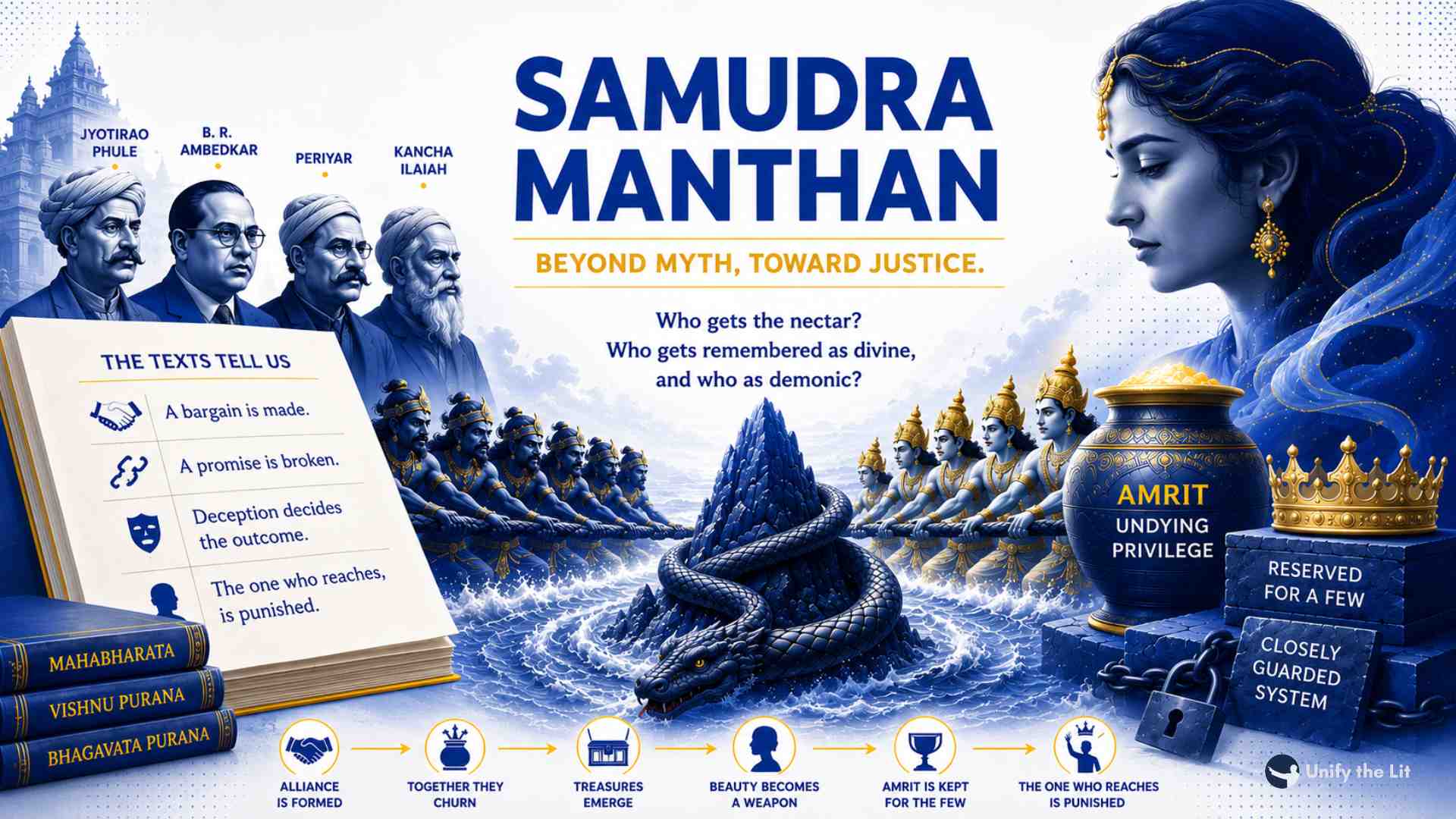
Every schoolchild in India knows the picture. Gods and demons, ranged on opposite banks, hauling a serpent wrapped around a mountain, churning the ocean until it gives up its treasures. It is one of the most reproduced images in Hindu art, carved into the walls of Angkor Wat, painted on temple ceilings, printed on calendars. We are taught to read it as a triumph: the gods win, the nectar is secured, cosmic order is restored.
But a story this old and this central is never just one story. Turn it a few degrees and a different picture surfaces, one about who holds wealth, who is allowed to keep it, and what happens to anyone who tries to take a share without permission. Read this way, the amrita is not merely nectar. It is a monopoly asset: a source of income and power that, once cornered, pays out forever and never dies. That second reading is not new, and it is not fringe. It runs through some of the most serious anti-caste and materialist thought India has produced. The question worth asking is not whether such a reading is possible, because it plainly is, but exactly how far it can be pushed before interpretation outruns evidence.
What the texts actually say
Start with the facts, because the allegory is only as strong as the story it rests on, and here the story is solid. The churning of the ocean, Samudra Manthan, appears across the Mahabharata's Adi Parva, the Vishnu Purana, and the Bhagavata Purana, with variations in the Padma and Skanda Puranas. The bones are consistent everywhere.
The gods, cursed into weakness, need amrita, the nectar of immortality, which lies at the bottom of the cosmic ocean. They cannot get it alone, so they strike a bargain with the asuras, their cousins and rivals, to churn together and share the spoils. Mount Mandara becomes the churning rod, the serpent Vasuki the rope, and Vishnu, as a tortoise, bears the mountain on his back. Fourteen treasures rise from the water: a wish-granting cow, a white elephant, the goddess Lakshmi (wealth itself, who chooses the gods' side), a deadly poison that Shiva swallows to save creation, and finally the physician Dhanvantari, cradling the pot of nectar.
Then comes the turn. The asuras seize the pot. And Vishnu, who promised an equal share, takes the form of Mohini, an enchantress of overwhelming beauty, and while the demons are transfixed, she serves the nectar only to the gods. The joint venture, in other words, is dissolved the instant the asset is in hand, and the junior partners are cut out of the distribution. One asura, Svarbhanu, sees through it. He slips into the gods' line in disguise and drinks. The Sun and Moon expose him, and Mohini beheads him on the spot with a spinning discus. But the nectar has already touched his throat, so he cannot die. His head becomes Rahu, his body Ketu, the two shadow-points that, to this day, are said to swallow the Sun and Moon during eclipses, in eternal revenge.
Every element the allegory needs is right there in the canonical text: a scarce and precious asset, a coalition built on a promise, a promise broken the moment the returns are secured, and a summary execution for the one who tried to claim his contracted share anyway. Nothing has to be invented. That is what makes the reading dangerous, in the good sense, for anyone invested in the innocent version.
The tradition of reading against the grain
The instinct to read the gods-versus-demons framework as a material rather than cosmic conflict has a long and respectable pedigree. It did not begin with any one family's dinner-table conversation; it begins, at the latest, with Jyotirao Phule's Gulamgiri in 1873, which read the myths of divine conquest as a coded memory of Aryan invaders subjugating an indigenous population and locking them into caste, which is to say, into a fixed and inherited economic position. In Phule's hands, the asuras were not monsters but the defeated original inhabitants, rebranded as demons by the victors who wrote the scriptures and drew up the ledger.
B.R. Ambedkar carried the argument further, and he understood the stakes as economic before they were anything else. In Riddles in Hinduism he insisted flatly that the asuras "were members of the human family and not monsters," that the deva-asura wars encode real history, the conquest of one people by another, later dressed as theology. Ambedkar's deeper point was that land, in the Indian context, is never merely an economic asset; it is a marker of social status and dignity, and denying it was how subordination was made permanent. In the Tamil south, Periyar E.V. Ramasamy rewrote the Ramayana entirely, casting Ravana as a dignified Dravidian king and Rama as the invading enforcer. And in Why I Am Not a Hindu, Kancha Ilaiah argued that the Brahminical gods "became heroes by waging wars," their glory built on the demonization of the very people whose labour they lived off.
Even a scholar as canonical as Wendy Doniger, in The Origins of Evil in Hindu Mythology, describes gods and demons as consanguine half-brothers divided like "two separate castes," each assigned a fixed job, which is as neat a description of a rigged division of labour as any economist could want. The Mohini episode is that arrangement enforced: divinity winning the surplus by disguise.
So the general framework, asuras as the dispossessed, gods as the monopolists, scripture as the victors' account book, is not a private theory. It is a documented, citable, century-and-a-half-old tradition. The single closest published parallel to reading Samudra Manthan specifically through this lens is Sumit Rajak's 2022 analysis of the Dalit film Teesri Aazadi, which reads the churning and the gods' monopoly of the nectar as "a conspiracy to befool the common people." The interpretive door, in other words, is already open.
Where the reading is strongest, and where it strains
This is where honesty has to do some work, because not every element of the churning allegory is equally well-supported, and pretending otherwise weakens the whole.
The strongest move in the entire reading is not Rahu at all; it is a figure from a different myth who rhymes with him perfectly. In the Ramayana's final book, a Shudra named Shambuka performs religious austerities forbidden to his caste. A Brahmin's son dies; the sages blame Shambuka's "unlawful" penance; and Rama personally seeks him out and beheads him, upon which the dead boy revives and the gods applaud. Ambedkar called it "the worst crime that history has ever recorded." Here the allegory needs no decoding at all. It is simply the plain text: a low-caste man is executed specificallyfor reaching toward power reserved for his superiors. Rahu, beheaded for drinking a nectar he was promised and then denied, is the same story told in the sky. The structural echo is exact. (This, almost certainly, is the figure garbled as "Sukandhka" in the original conversation, worth confirming before building on it.)
The amrita-as-monopoly-asset reading is more of a leap as a claim about authorial intent, but as a claim about economic function it is unusually well-grounded, because the same scriptural tradition that tells the story also wrote the rule that makes the metaphor literal. The Manusmriti flatly prohibits wealth accumulation by the lowest caste: no Shudra should collect wealth even if he is able to, the text warns, because a Shudra who acquires wealth causes pain to Brahmins. That is not allegory. That is written law barring the outcaste from the one thing that would let him drink the nectar, capital, and it is quoted directly in the anti-caste literature on landlessness precisely because it states the economic logic out loud. What no named scholar does, to be exact, is build the specific thesis that "the pot of nectar in Samudra Manthan is a symbol of an upper-caste income monopoly." That precise equation is an original synthesis, intellectually continuous with Phule, Ambedkar, and the Manusmriti evidence, but not found, word for word, in the literature, and it should be presented as an extension of the tradition rather than a citation from it.
The same caution applies, even more so, to reading Mohini as "using women as a weapon against Dalits." That Mohini's beauty is weaponized as a tool of deception is textually undeniable and has been noted by feminist critics. But the further step, that her femininity is aimed specifically at the lower castes, is an interpretive bridge no scholar was found to have built. It may be a compelling intuition. It is not, yet, a documented one.
The economics of an undying privilege
Here is where the metaphor stops being a metaphor. If the amrita stands for an asset that pays out across generations and never dies, then the question is simply whether the returns in modern India actually flow the way the story predicts. They do, and the numbers are not subtle.
A World Inequality Lab study found that roughly 88 per cent of India's billionaire wealth is controlled by the upper castes. Scheduled Castes make up about 19 per cent of the workforce but only around 11 per cent of enterprise owners, while the historic bar on land ownership, the original denial of the means of production, still shows up in today's landlessness data, where Dalit and Adivasi households are overwhelmingly landless or hold only marginal plots and depend on wage labour on other people's fields. Land, as Ambedkar insisted, was never just income; it was standing, security, and the ability to say no. Deny it for long enough and the denial compounds like interest.
This is the empirical spine the mythological reading was always pointing at. Whatever one concludes about the intent of a two-thousand-year-old text, the outcome it describes, a nectar of wealth and power hoarded on one bank and withheld from the other, is a measurable feature of the present economy. The story does not have to be a conscious blueprint for the pattern it names to be real. The disparity is documented; the debate is only about how much of it descends from the arrangement the myth dramatises, and how much from causes a modern economist would name differently.
The living examples, and their limits
The most provocative part of any such reading is always the leap into the present: the claim that the ancient pattern of elevate, then behead still runs today, that any lower-caste figure who accumulates a following, and with it economic and social leverage, gets destroyed by defamation.
Some of the historical evidence for this is genuinely powerful. The 1978 destruction of Jagjivan Ram, the towering Dalit leader who stood on the threshold of becoming India's first Dalit Prime Minister, is a near-textbook case. His prospects were gutted when explicit photographs of his son Suresh Ram were splashed across a magazine then edited by Maneka Gandhi, in what is widely remembered as India's first orchestrated political sex scandal. The pattern of a rising Dalit family cut down by a well-placed sexual smear is not paranoia here; it is the historical record. Likewise the 2019 demolition of the Guru Ravidas temple in Delhi, which detonated mass Dalit protest precisely because it read, to millions, as an attack on a sacred site of the Chamar community, the community of the fifteenth-century saint Ravidas, guru to the Rajput princess Mirabai, whose very trans-caste following made him the kind of figure the pattern predicts would be targeted.
But the argument overreaches the moment it tries to fold in the convicted godmen. Asaram is serving a life sentence for the rape of a sixteen-year-old. Gurmeet Ram Rahim Singh, whose Dera Sacha Sauda genuinely draws a vast Dalit and lower-caste following, was convicted of raping two disciples. Osho's Oregon commune carried out the largest bioterror attack in U.S. history, deliberately poisoning 751 people. To file these downfalls under "upper-caste defamation of rising outsiders" is to collapse a real historical pattern into a conspiracy theory that swallows genuine crimes. The framework that illuminates Jagjivan Ram obscures Asaram. A serious reading has to be willing to say so, to hold that some of these men were smeared and that some were simply guilty, and that the difference matters.
What the churning finally shows
So what survives when the exaggerations are stripped away? A great deal, actually.
The orthodox reading of Samudra Manthan, that it is an allegory of spiritual effort, the churning of one's own mind to extract the nectar of self-realization, remains available and, for most believers, primary. Nothing here erases it. But an ancient story can carry more than one cargo, and the political-economy reading is not a distortion smuggled in from outside. It draws on the same tradition that gave India Phule, Ambedkar, and Periyar, and it fastens onto details the text itself provides: a joint venture, a promise of equal sharing, a betrayal executed the instant the asset is secured, and a beheading for the one who dared to claim the return he was owed.
This is essentially the reading advanced by सम्राट जोगेन्दर सिंह बौद्ध former Deputy General Manager (Finance) at Air India Limited, a man who came to it not from an armchair but by working outward from the texts across years, sifting a great many sources and travelling to the sites themselves to see what the stories had left behind in stone and ritual. It is perhaps no accident that a finance man reads the myth this way, because he recognises the shape of the thing: a scarce asset, a controlling stake, a minority partner squeezed out, and a moat built to keep the returns flowing to the same hands forever. His interpretation is at its most honest, and most devastating, when it stays close to that structure, when it asks not for elaborate modern conspiracies but simply why, in so many of these foundational stories, the one who reaches above his assigned station ends up with his head on the ground while the gods cry "well done." Rahu got the nectar and lost his head. Shambuka got his austerity and lost his head. Read as Singh reads it, the churning myth does not have to be a secret manual of oppression to be a mirror. Sometimes a culture's oldest stories tell you exactly what it fears, and exactly what it is willing to do to keep the nectar on one side of the bank.
The most useful thing an interpreter can do with a story this powerful is refuse the easy version in both directions: neither the pretense that it is only about self-realization, nor the overreach that turns every fallen figure into a martyr. Read it at its full strength and no further. That is where it does its real cutting, and where the ledger it describes is still open.
Author's note
I did not come to this story only through books. I came to it through a smaller, more ordinary version of the same churning, and I will not pretend I am writing about it calmly. I was once part of a circle out of IIM Kozhikode, more than ten groups in all, and I paid my equal share to be in them and did my equal share of the work. For a while the venture held, because I was useful: a crowd face to fill the room when companies came visiting for placements, a pair of hands on the projects, a fraction of my future salary owed up to the administration like everyone else, a name parked on the C-minus side of every bell curve so that someone else's could sit higher. Useful, in other words, as long as I was churning and asking nothing back. Then the moment I turned inconvenient, the moment I raised a voice against the quiet Brahminism running through the place, the arrangement dissolved exactly the way it does in the myth: the equal partner was reclassified as a problem and removed, the contribution forgotten the instant the work was banked. And it was not once. It was consistent, one group after another, the same quiet arithmetic each time, until the regularity stopped looking like accident and started looking like design. I am angry about it, and I have decided the anger is worth keeping, because it is the honest response to being made to pay in full and then treated as disposable. I will not pretend my exclusions sit on the same scale as the historic violence this essay describes, because they plainly do not. But the shape is identical, and once you have felt the shape you cannot unsee it: contribute as an equal, stay quiet, and you are tolerated; contribute as an equal and then name what you see, and you are not argued with, you are erased. So I am putting it in writing instead of swallowing it. The gatekeeping I met was not neutral, whatever it tells itself, and I am no longer willing to protect the comfort of a machinery that runs on quiet exclusions and then dares the excluded to stay silent about them. That is what the churning has always been about. Not the poison, not even the nectar, but who is allowed to keep standing at the rope once the work is done, and who is expected to sink to the bottom and be grateful for the invitation to drown. I am declining the invitation.
Liked this story?
Discover more voices from the Dalit storytelling archive — reflections, struggles, and steps to transform our future.
Browse all stories