
Ten Minutes to Your Door. Two Thousand Years in the Booking.
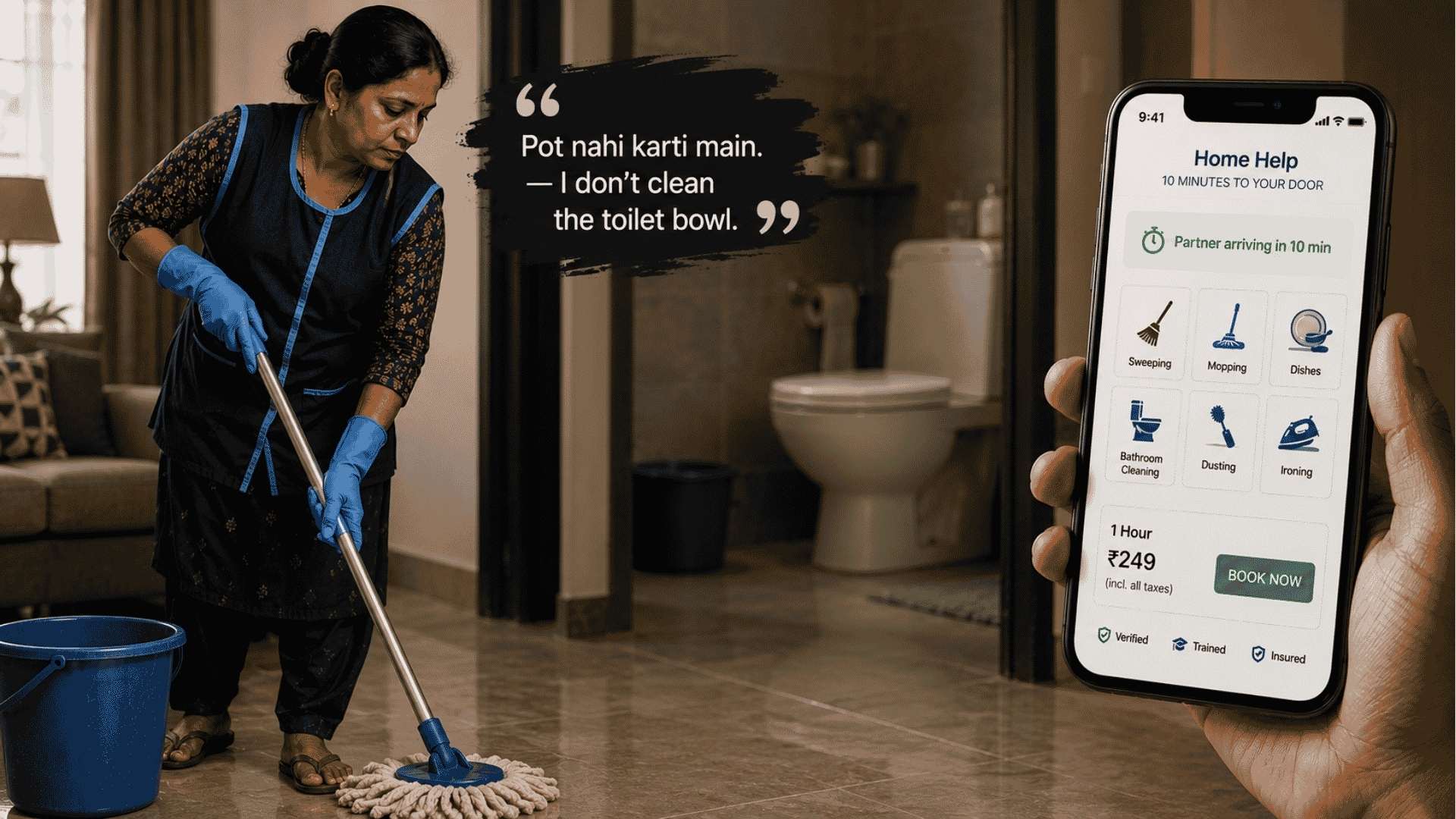
She mops the floor. She wipes the tiles. She scrubs the utensils until the sink shines. There is one thing she will not do.
"Pot nahi karti main," she says I don't clean the toilet bowl.
I had booked a single hour through one of the new ten-minute home-help apps. A worker arrives at your door faster than a pizza; you tap, you pay, someone trained and verified is mopping your home before the surge price on a cab would have settled. This is the promise that has pulled hundreds of crores in venture capital into Indian living rooms over the last two years. The pitch is always the same, and it is always one word: dignity. Dignified work. Dignified earnings. The informal maid, formalised and lifted up.
So I asked her. Plainly, owning the question - I was the one who raised caste, not her. You're a Brahmin. Why are you doing this work?
Family compulsion, she said. The hours suit her ten to three, not the eight-hour shifts a company would demand. Reasonable, human answers. But then the conversation drifted to the work itself, and a much older grammar surfaced, intact, beneath the app's clean interface.
She does floors, tiles, dishes. She does not touch the pot. When I asked about the man who collects the garbage from her own home, whether he might do the toilet too, she answered without a pause: "Unka yahi kaam hai, kooda le jaana." That is his only job. To take away the refuse.
I want to be exact about what happened here, because the whole point of this piece is to be exact. A worker, doing manual cleaning for a living out of economic necessity, drew one precise line and she drew it at the toilet bowl. Not at floors. Not at dishes. At the single point in any home where labour comes closest to human excreta. That is not a random preference. That is the oldest boundary in the Indian moral imagination, surfacing inside a Series-D startup's booking flow.
The line nobody on the app can see
How does the app handle a worker who won't do the very task the app advertises? It doesn't. It can't see her at all.
She explained the workaround, the one everybody on the platform seems to know. You don't refuse on the app refuse after the OTP and money gets deducted, hers or yours. So you reschedule. You "change the region," adjust the time, say not this one, send someone else. The booking quietly reroutes. Someone else arrives. The task gets done. And the platform records a clean transaction, a happy customer, a completed job and learns nothing, because by design there was nothing to learn.
Even the training, she said, is sanitised. The dummy bathrooms they practise on aren't filthy; the trainers smear a brown sauce on the fixtures and the dishes so there is something to wipe. The reality of the work is simulated away before the worker ever meets it. The app abstracts the booking. The training abstracts the dirt. And somewhere in all that abstraction, the one thing that actually governs who does what in an Indian home "caste" disappears from view while continuing to run the whole machine.
"Dignity," and the word it cannot say
Here is the part that should trouble anyone who takes these companies at their word.
These platforms do not market themselves on speed alone. They market themselves on dignity. Their mission statements speak of dignified earning opportunities, of helpers who finally earn with dignity, of an informal trade lifted into the formal economy. Their service menus list bathroom cleaning casually alongside sweeping, dusting, dishwashing and ironing one neutral item in a tidy bundle, priced by the hour.
But you cannot deliver the dignity of labour in India while refusing to name the thing that strips labour of its dignity in the first place. The indignity attached to cleaning a stranger's toilet is not a universal squeamishness. It is a specific, engineered, two-thousand-year-old indignity. It has a name. The platform will say sweeping, mopping, bathroom cleaning. It will not say caste. And in this country, to be silent about caste is not to be neutral about it. It is to let it run unexamined.
This is the coherence gap at the centre of the whole model: a company that sells dignity, built on top of a labour reality structured entirely by caste, that has as far as any public statement reveals no policy on caste at all. Not for its workers. Not for the customers who may be sorting those workers by surname without anyone in the building ever logging it.
Disgust was doing the routing all along
This is where it helps to think like Babasaheb taught us to think - structurally, and without flinching.
Caste is not only the story of the powerful crushing the powerless from above. It is a graded ladder of purity and pollution that conscripts everyone standing on it, top to bottom. That is why our Brahmin worker is not a contradiction to the story she is the clearest illustration of it. Economic necessity had flattened her into a gig cleaner, doing the same hourly manual work as anyone else on the app. And still she carried the gradient with her. She drew her line exactly where caste has always drawn it: at the membrane between the merely dirty and the truly polluting, at the pot, at the proximity to human waste.
The affect doing that sorting is disgust. Not policy, not a database, not a dropdown in the app disgust, the feeling, operating below the level anyone has to admit to. Ambedkar showed us how caste fixes itself through endogamy and inheritance. Thinkers like Martha Nussbaum and William Miller have shown how disgust gets recruited to mark some human beings, and some human tasks, as contaminating. Put the two together and you have what I watched happen in my own flat: a platform that digitised the booking but did absolutely nothing to the hierarchy underneath it. The app got faster. The sorting stayed exactly as old as it has ever been. The technology simply gave it a clean surface to run on.
What I am not saying
Movement writing earns its authority by being precise about its own limits, so let me be precise.
I am not saying this company keeps caste files, or deliberately matches "untouchable" tasks to lower-caste workers. The recording does not show that, and one detail actively cuts against it - the routing she described keys on region, on geography, not on jaati. To claim otherwise would be to invent a villain, and we do not need to invent anything.
I am also not pretending the informal economy these apps replace was some lost utopia of dignity. For many women, a formal contract, an Aadhaar-linked bank account, insurance and a steady wage are real gains over the old arrangement of unpredictable, unprotected domestic work. That is precisely why this matters. Because these platforms present themselves as the modern, formal, dignified alternative, their blindness to caste is not a small omission. They have become the new face of domestic labour in urban India and they are reproducing its oldest sorting mechanism while sincerely believing themselves to be neutral. This is not the cruelty of bad people. It is the negligence of good intentions that never thought caste was their problem to solve.
What dignity would actually require
So we are not asking these companies to feel guilty. We are asking them to be coherent to make their conduct match their branding. Four things would do it:
Name the work, and let it be chosen. Toilet and sanitation cleaning should be a distinct, clearly disclosed, fairly compensated, opt-in task not a line silently folded into "house help." No worker should be quietly routed into excreta-proximate labour by a reschedule she can't see.
Stop penalising dignity. A worker should never lose money for declining work on grounds of dignity or safety. The "OTP daalne ke baad paise kat jaayenge" trap punishes exactly the refusal a dignity-first company should protect.
Write the policy that doesn't exist. A public anti-caste-discrimination commitment, covering both workers and the customers who may be sorting them and a clear statement of how routing is designed to prevent, rather than quietly enable, caste-based selection.
Say the word. A company cannot claim to restore the dignity of Indian domestic labour while treating caste as if it were not in the room. Dignity that cannot say "caste" is a marketing slogan, not a value.
I have withheld every detail that could identify the worker who spoke with me. She owes us nothing; she was doing her job. The point was never her. The point is the machine she works inside a machine that can put a trained, verified person at your door in ten minutes, and still cannot see the two thousand years that decide which of them touches the pot.
We built Unify the Lit to make exactly this visible to raise the consciousness that lets a person, a company, a country notice the sorting it has stopped noticing. An app that flattens everything about domestic work except its caste is not a glitch in modern India. It is modern India, running its oldest software on a brand-new screen.
The least a company selling dignity can do is read the code it's running.
Jai Bhim. 💙
Unify the Lit is an Ambedkarite platform for Dalit voices, mutual aid, and the long work of caste consciousness. If you have encountered caste sorting on a digital platform as a worker or a witness we want to hear from you.
Liked this story?
Discover more voices from the Dalit storytelling archive, reflections, struggles, and steps to transform our future.
Browse all storiesPass it forward
Know someone who needs stories like this? Bring them into the movement through our Referral Circle.
 Join the Referral Circle