The Psychology of Worshipping Monkeys and Elephants
The experiment
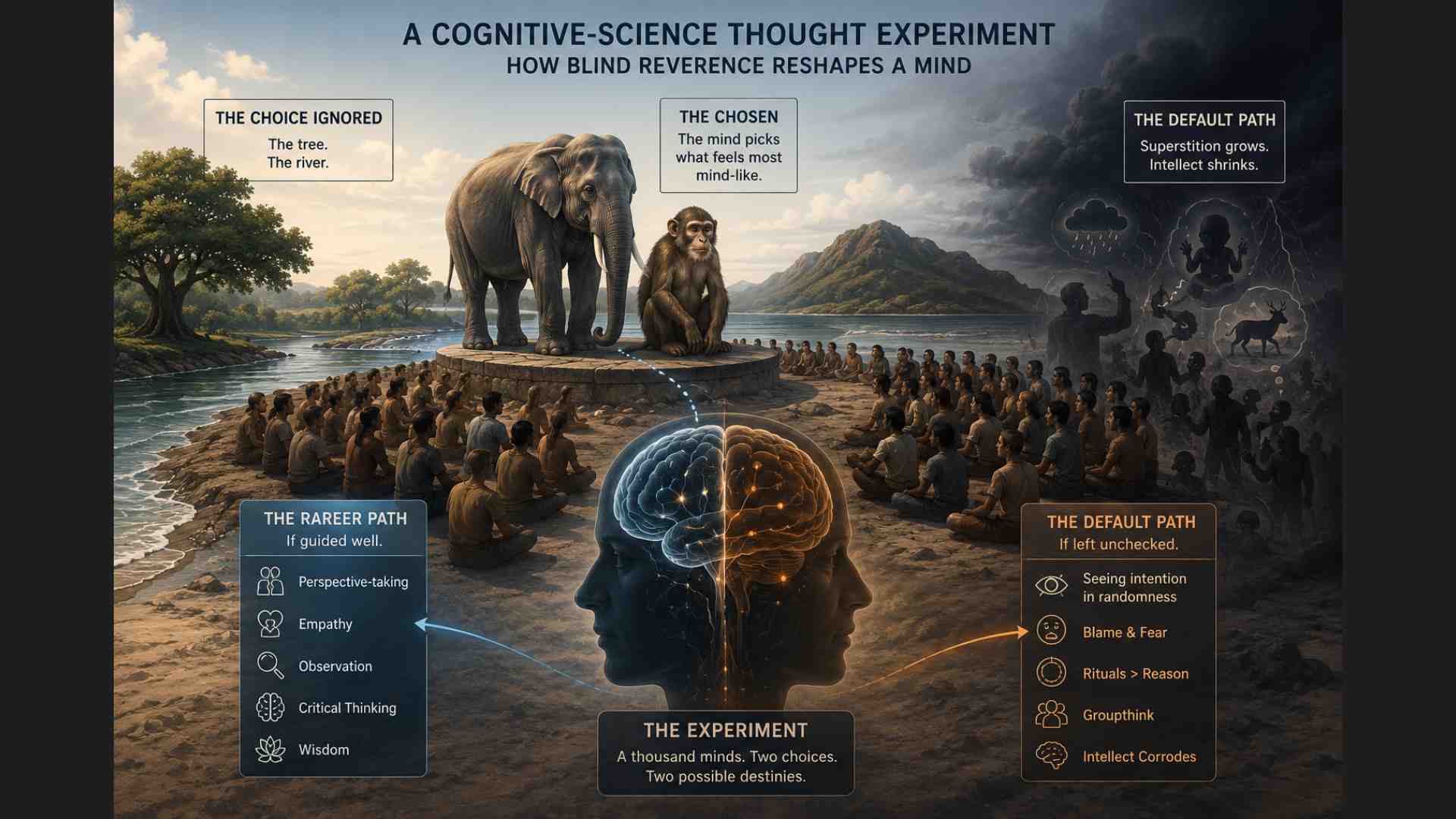
Picture an island. A thousand people, cut off from the world, starting from nothing, with no inherited creed, no scripture, no authority telling them what is holy. One day they begin to ask the questions that have no easy answers: why are we here, why do we die, what moves in the dark beyond the fire. And when they reach for something to revere, they pass over the great tree at the island's centre and the river that feeds them, and settle instead on two animals, the elephant and the monkey.
This is a thought experiment, not a history. Its purpose is to ask what the science of the mind predicts will follow. It is tempting to narrate this hopefully, to see reverence as a school for empathy and a curriculum for wisdom. That optimistic branch is real, but it is the harder and rarer one. Left to run on its default settings, the same cognitive machinery that builds the reverence tends to corrode the intellect it engages. This piece follows that darker and considerably more probable path, because it is the one the evidence better supports.
The machinery is a by-product, not a gift
Start with a sobering premise from cognitive science: the disposition to worship is very likely not an adaptation designed to make us wise. It is better understood as a by-product, a side-effect of mental systems that evolved to do other jobs. Agency-detection evolved to spot predators, not to find gods. Face-and-gaze circuitry evolved for social life, not for meeting something sacred in an animal's eyes. Pattern-detection evolved to find real regularities in the world, and misfires constantly in the process. Worship, on this account, is simply what these systems produce when they are pointed at the unknown, an overspill rather than an accomplishment.
This matters enormously, because a by-product carries no promise of being good for the organism that runs it. It is not tuned for truth or for flourishing. It is a machine doing roughly what it was built to do, in a situation it was never built for. Everything that follows is the consequence of taking that machine seriously as a guide to reality.
Why the mind reaches, and why it misfires
Three well-studied features of cognition make the reaching-for-reverence close to inevitable in a group that has begun to question its own existence. Read carefully, each is also a reason to distrust the result.
- Mortality awareness. Humans know they will die, and that knowledge generates a low, chronic anxiety that the mind soothes by building symbolic structures larger and more permanent than the body. But notice the selection pressure: a belief adopted this way is chosen because it comforts, not because it is true. Consolation and accuracy are different things, and here consolation wins.
- Runaway pattern- and agency-detection. The brain is built to over-detect intention, since it is safer to mistake wind for a predator than the reverse. A mind tuned to see too much agency will go on seeing it everywhere, long after the animals are chosen. This is not the seed of insight; it is the seed of superstition.
- The hunger for shared meaning. Beliefs that bind a group spread by emotional resonance and social contagion, not by evidence. What unites the thousand is whatever feels most binding, which has no reliable relationship to whatever is actually the case.
So the very features that make reverence feel profound are features tuned for survival and cohesion, and indifferent to truth. The feeling of depth is not a signal that something true has been found.
Why an animal, and not the tree or the river
Faced with a tree, a river, and an elephant, the mind does not weigh them evenly. Agency-detection, face-and-gaze circuitry, mind-attribution, bodily resemblance, and sheer memorability all bias it toward the most mind-like thing available, and on this island that is the elephant and the monkey. But note the tell in this: the animals are chosen not because they explain anything, but because they trip the most alarms in a mind hungry for agents. The selection criterion is salience, not explanatory power. From the very first step, this is not a truth-seeking process. It is a most-vivid-candidate-wins process, and vividness and truth are unrelated.
Where the intellect actually goes: superstition as the default
Now to the heart of the question, what happens to the mind. The hopeful story says that revering minded creatures exercises perspective-taking and trains close observation. Both can happen. But the dominant, default output of the same machinery is superstition, and the mechanism is precise.
Agency-detection does not switch off once the animals are chosen. It keeps firing at everything ambiguous, the drought, the stillbirth, the fortunate hunt, and each becomes an act of will by the revered animal. The mind now systematically reads intention into randomness and blame into misfortune. This is not a harmless decoration on top of otherwise sound thinking; it is a corruption of causal reasoning in exactly the place reasoning matters most, the explaining of why things happen. Ritual gets aimed at outcomes it cannot affect. And when the drought lifts on its own, the mind files the coincidence as proof, so the feedback loop that should have corrected the false belief instead cements it. A worldview that converts every coincidence into confirmation is, by design, unfalsifiable, and an unfalsifiable worldview is one the intellect can no longer escape from within.
Sacred values switch off reasoning
There is a second, sharper cost, and it strikes reasoning directly. Once something is treated as sacred, the mind stops treating it as something that can be weighed. Experimental work on "sacred values" finds that people refuse to trade a sacralised value against material costs, and, tellingly, are morally offended by the mere suggestion of a trade-off, sometimes digging in harder when offered incentives to compromise. This is the deliberate suspension of the very faculty we call rational thought: the weighing of costs against benefits and the revising of a position under new evidence. A sacred domain is, by construction, a fenced-off region where reasoning is not permitted to operate. The more of life the thousand declare sacred, the more of their own minds they wall off from correction, and they will experience each new wall as wisdom rather than as loss.
The society this builds, and its built-in pathologies
The hopeful reading said that a revered animal's traits become a people's ideals, yielding reverence for elders and a taste for ingenuity. That pleasant surface can appear. But underneath it, the same social machinery reliably manufactures four pathologies, and they are not rare malfunctions. They are the ordinary output.
- The interpreter's power. A sacred always breeds specialists who claim privileged access to its meaning, those who can say what the elephant wants. That is an authority structure with no external check and a permanent incentive to manipulate, routing resources, status, and obedience through the interpretation. Cohesion and a rent-seeking priestly class arrive as a single package; you cannot order one without the other.
- Parochial altruism. The very psychology that makes people sacrifice for their in-group also makes them hostile to outsiders; the two appear to have co-evolved. Solidarity has a hard outer wall by definition. And the wall need not face outward, since the island can fracture from within into an elephant faction and a monkey faction, manufacturing sectarian conflict out of nothing but a difference of totem. Reverence hands tribalism a banner to march under.
- Moralisation and the death of dissent. Sacralising purity, memory, and tradition recruits the emotion of disgust and the psychology of contamination against anyone who deviates. Norm-violation stops being mere error and becomes pollution; the curious, the questioning, and the simply different become heretics to be shunned or punished. This is the exact reversal of the empiricist hope: the person who looks too closely and reports something inconvenient is the first to be silenced. A culture that punishes heresy is a culture actively selecting against curiosity.
- The costly-signalling ratchet. Rituals endure partly because they are expensive, and expense credibly signals commitment. But cost is a ratchet: to prove more devotion than one's neighbour, the price keeps rising, meaning more time, more sacrifice, more prohibition, and at the extreme self-harm or the destruction of genuinely useful things. A rite that began as harmless bonding can grind, generation by generation, toward real and compounding harm, with the cost of belonging climbing the whole way.
The narrow branch where it goes right
Honesty cuts both ways, so it is worth stating plainly that the hopeful outcome can occur, because it genuinely can. The intellect is sharpened rather than dulled, and the society humane rather than harsh, but only under specific and fragile conditions: if the people keep observing the real animals and let what they see override doctrine, so that empiricism survives inside the reverence; if interpretive authority stays distributed rather than captured by a class; if outside pressure stays low enough that cohesion never hardens into militancy; and if the sacred stays small enough to leave most of life open to ordinary reasoning.
These conditions are achievable. But notice what every one of them is: a brake, fighting against the default motion of the machinery. The good outcome is not what the system produces when left alone. It is what a system produces only when it is actively, continuously restrained. That asymmetry is the whole point. The humane island demands constant vigilance; the corrosive one demands nothing at all.
What the experiment actually shows
Strip away every named tradition and the sober conclusion still stands. The disposition to worship is a by-product of survival machinery, indifferent to truth, and its untended tendency is to corrode rather than to sharpen. The thousand chose the elephant and the monkey not because those animals explain anything but because they trip the most alarms in a mind starved for agents. From there, the mind that might have watched and learned is far more likely to read intention into accident, fence its deepest questions off from reasoning, surrender power to those who claim to interpret, harden its bonds into hostility, and punish the very curiosity that could have rescued it.
None of this makes the thousand foolish. It makes them human, running well-documented cognitive software with well-documented failure modes. The optimistic version of this island is real, but it is conditional, bought only through constant effort against the mind's own defaults. The pessimistic version needs no effort whatsoever. It is simply what happens when reverence is allowed to run blind.
Liked this story?
Discover more voices from the Dalit storytelling archive — reflections, struggles, and steps to transform our future.
Browse all stories