
Dr. Ambedkar asked us to annihilate caste. We couldn’t. So we built a way to measure it.
Be honest with yourself for one paragraph.
You know the feeling. The small, warm satisfaction of being above someone: a better college, a purer surname, an older family, a fairer skin, a corner office, a “cultured” neighbourhood. Every human being has tasted it, and most of us have craved more of it. This is not a Dalit problem or a Brahmin problem or a Hindu problem. It is a human craving. What makes India different is that we are the only civilisation that took this craving and engineered it into a system, refined over three thousand years, with a rank for everyone.
Dr. Ambedkar saw this more clearly than anyone before or since. Caste survives, he explained, not because a few people at the top enforce it, but because it is graded inequality: an ascending scale of reverence and a descending scale of contempt, in which almost everyone has someone to look down upon. The system doesn’t need your hatred. It only needs your small, warm satisfaction. That is why he wrote that caste is not a wall of bricks that can be pulled down. “Caste is a notion; it is a state of the mind.”
And a state of the mind lives in every mind. Ambedkar documented, in Annihilation of Caste itself, that caste operates among Indian Muslims, Sikhs, and Christians too. Conversion changed the prayer, not the hierarchy. So if you are reading this thinking this is about someone else, whether you are a Savarna reader, a Muslim reader, a Christian reader, or an “I honestly don’t see caste” reader, Babasaheb’s answer is that the system is counting on exactly that thought. The mirror takes three minutes: take the CCI.
He asked for annihilation. We are ninety years late.
In 1936, Ambedkar wrote the most radical prescription in Indian history: not reform, not softening, but annihilation. Destroy the notion at its root. He warned us of the alternative in the Constituent Assembly in 1949: a country entering a life of contradictions, with equality in politics and inequality in social life, and he asked how long we could live that contradiction before it destroyed what we had built.
Ninety years after 1936, the honest answer is: the annihilation has not happened. The monster he described, the one that crosses your path whichever direction you turn, is still on the path. It has learned English, cleared entrance exams, moved into gated societies, and hidden itself inside the word “merit.”
So here is our position, stated plainly. Annihilation remains the destination, his and ours. But when a disease resists cure for ninety years, medicine does not give up. It does the next rigorous thing: it measures. You cannot fix what you refuse to see, and you cannot see what you have never measured. Babasaheb’s own sequence begins with Educate, and the first education is an honest account of your own mind. That account is a click away: measure yours here.
Measurement is not a compromise. It is method.
The world’s most serious thinkers on progress agree on the sequence: see it, count it, then change it. Three references, if you want to go deeper:
1. Lord Kelvin, “Electrical Units of Measurement” (1883). The founding statement of scientific method: when you can measure what you speak of, you know something about it. When you cannot, he warned, your knowledge remains “of a meagre and unsatisfactory kind.” For ninety years, India’s knowledge of its own casteism has been exactly that: felt everywhere, measured nowhere.
2. Douglas W. Hubbard, How to Measure Anything (2007). Hubbard’s life’s work is dismantling one excuse: “this is intangible, it can’t be measured.” Trust can be measured. Culture can be measured. Bias can be measured. Anything that matters leaves observable traces, and a mind’s relationship with caste leaves more traces than most.
3. Abhijit Banerjee & Esther Duflo, Poor Economics (2011). The Nobel-winning demonstration that India’s hardest social problems yield not to ideology or good intentions, but to patient, honest measurement of what is actually happening. Poverty began to move when we started measuring it properly. Caste consciousness deserves the same rigour.
And one reference closer to home: Babasaheb himself. Before he was a liberator, he was an economist and statistician. The doctoral theses, the memoranda to commissions, the chapter he titled simply “Untouchables: Their Numbers.” He never argued with sentiment when he could argue with evidence. The CCI is built in that tradition.
Why an index for India, specifically
Consider what India measures about caste, and what it doesn’t. The last full caste census was in 1931. For six decades afterward, policy for millions ran on those colonial-era numbers; the Mandal Commission itself had to reach back to 1931 data. Bihar counted again in 2023, and a national caste enumeration has now been announced for the coming census. That counting matters, and Ambedkarites fought for it.
But every census answers only one question: who exists. No instrument in India has ever measured the other half of Babasaheb’s diagnosis: how people see. If caste is a state of the mind, then the mind is where measurement must eventually go, individual by individual, repeatable, comparable, public. That is the gap the Caste Consciousness Index exists to fill. A census counts bodies; the CCI reads minds, starting with your own. For a country that runs on scores, from CAT percentiles to CIBIL to board results, this is the one score that measures whether we can live together as equals. A more caste-conscious India is an India with fairer classrooms, fairer workplaces, and fewer atrocities met with silence. It is also, one measured mind at a time, a real path back to the annihilation he asked for.
This has never been done before. Help us build it right.
We will say this plainly too: the CCI is a first. No one, in India or anywhere, has built a public, individual-level instrument for caste consciousness before. That means version one will have rough edges, and we would rather sharpen them with you than pretend they don’t exist. If a question felt unclear, unfair, too easy, or brilliantly uncomfortable, take the test and then tell us. Write to unifythelit@gmail.com or share feedback from your result page. Every serious critique makes the instrument harder to dismiss. This is what “organize” looks like in practice: an instrument the community itself refines.
The Caste Consciousness Index: a mirror with a number
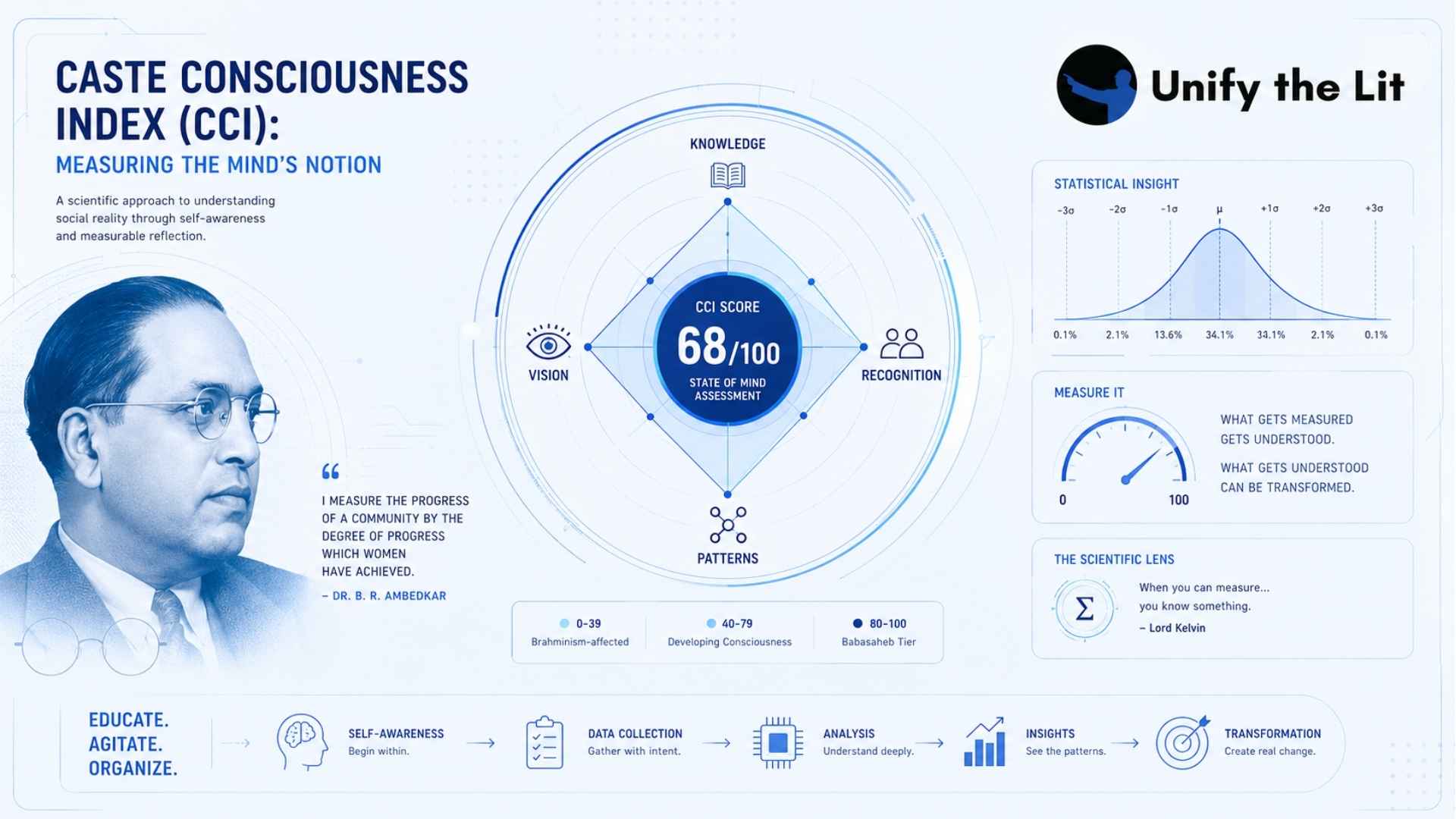
The CCI is a ten-question assessment, three minutes long, that measures how clearly you see caste. Not how good a person you are, but how clearly you see. Every question belongs to one of four domains: Knowledge (has the real history reached you, or only the sanitised one?), Recognition (when caste harm happens in a classroom, hostel, or office, can you name it?), Patterns (do you see the structure inside “pure-veg only” flats, surname-curiosity, and the merit myth?), and Vision (do you know the path Ambedkar actually laid out?).
Before you begin, you rate your own caste-awareness out of 100. Then the instrument gives you its number. For educated India, that gap between the awareness you claimed and the awareness you measured is the whole point. We have met very few people whose two numbers match.
Your score places you in one of four bands, and we named them without euphemism, because polite language is one of the structure’s survival strategies. The top band is the Babasaheb Tier. The bottom band, 0 to 39, is called Brahminism-affected. Read that carefully: Brahminism, not Brahmins. Ambedkar was precise about this. Brahminism is the negation of liberty, equality, and fraternity, and it can inhabit any mind of any caste and any religion, including, he warned, the minds of the oppressed themselves. The band is a diagnosis, not an insult, and the prescription is his: education. Every wrong answer comes with an explanation rooted in his writings and in Indian law. The retake button is always there.
One more design decision: your score is public. You get a shareable link anyone can verify. In a country where everyone privately believes they are caste-blind, we think consciousness should be a record you can stand behind, not a feeling you can claim.
More than 2,400 people have their number. Take the CCI: free, 3 minutes →
The measurement is the front door. The house is bigger.
Unify the Lit is Babasaheb’s Educate, Agitate, Organize built as working software: a digital home for Dalit dignity, education, and resistance that is open to every honest mind.
Learn. Every word he wrote, across 17 volumes and 400+ topics with full-text deep search, plus five interactive Revelations decks, an AI you can question that answers only from his writings (in English, हिंदी, मराठी, தமிழ், తెలుగు), and Walk His Path, which turns his ladder from Mhow 1891 to the Constitution 1949 into a tool for building yours. Explore Dr. Ambedkar’s Hub.
Connect. The Bhim Board, the Achievement Centre, the Art Corner: community without the trolling and invisibility generic platforms impose.
Mentorship. Certified Ambedkarite, trauma-informed mentors, with free sessions for eligible members, because the networks others inherit, our people have to build. Become a mentor.
Act. A confidential space to document caste discrimination, and for institutions, the OCCS, so organisations can be measured the way individuals are, leaderboard included.
Start where he told us to start
Educate. Agitate. Organize. The order was deliberate. Agitation without education is noise; organisation without education is a mob. Education begins with the self. Babasaheb quoted the Buddha on this: the cultivation of the mind is the ultimate aim of human existence.
So cultivate. Get your number. Sit with the gap between who you thought you were and what the instrument found. Whatever your caste, whatever your faith, whatever your certainty that this article was about other people, the mirror takes three minutes.
The craving to be above someone is human. Choosing to see it clearly: that is Ambedkarite.
Take the CCI → · Explore Dr. Ambedkar’s Hub → · Become a mentor →
Jai Bhim. 💙
Liked this story?
Discover more voices from the Dalit storytelling archive — reflections, struggles, and steps to transform our future.
Browse all stories