

Comments
Highlight color
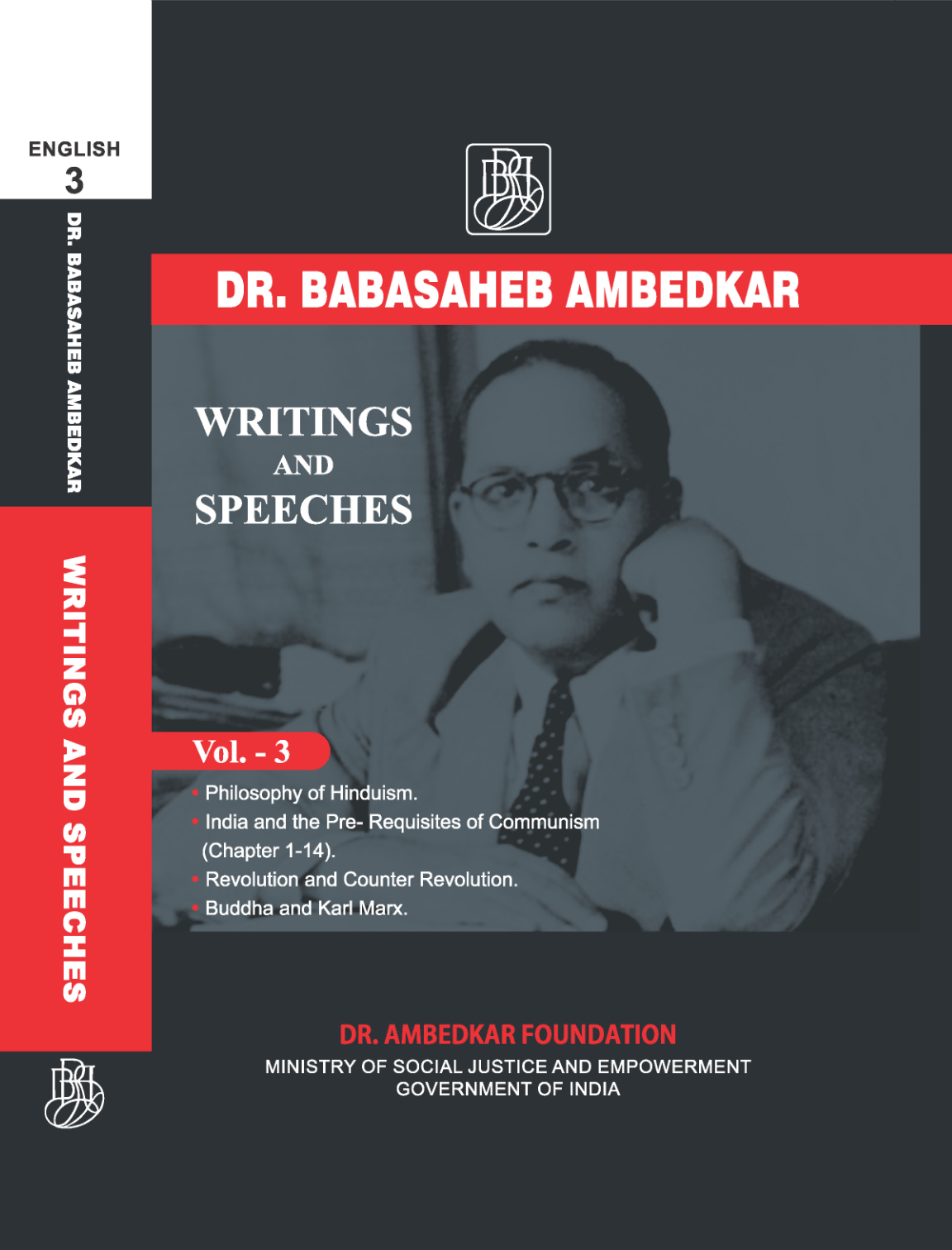
Volume 3 of Dr. Babasaheb Ambedkar: Writings and Speeches brings together his speeches, addresses, and statements delivered during the late 1930s and early 1940s, a turbulent phase in India’s political journey. The collection reflects Ambedkar’s sharp insights into the Indian social order, his critique of Hinduism, and his vision for social, economic, and political justice. It also records his engagement with constitutional reforms and the question of minority rights during the run-up to India’s independence. A significant part of the volume is devoted to his work on the Philosophy of Hinduism, where Ambedkar examines religion not merely as belief but as a scheme of social governance. He critiques Hinduism for sanctioning inequality through the caste system and highlights how its social order denies liberty, equality, and fraternity—the essential elements of justice. His arguments reveal Hinduism’s structural flaws, especially the hierarchical organization of society and the systematic subjugation of women and the Shudras. Another major section deals with Revolution and Counter-Revolution in Ancient India, in which Ambedkar analyses the decline of Buddhism and the resurgence of Brahminism. He traces how reform movements were systematically crushed, how Brahminical dominance reasserted itself, and how women and lower castes bore the brunt of this counter-revolution. These chapters underscore his belief that India’s social stagnation and inequality were products of conscious historical processes. The volume also contains Ambedkar’s comparative reflections in Buddha or Karl Marx, where he examines the two thinkers’ approaches to social transformation. While he acknowledges Marx’s emphasis on class struggle, he favors the Buddhist path of non-violence, compassion, and moral transformation as a more sustainable and humane route to social justice. This section illustrates Ambedkar’s attempt to reconcile modern socialist thought with an ethical, indigenous framework rooted in Buddhism. Throughout the volume, Ambedkar insists that political freedom without social and economic equality is meaningless. His interventions in labour policy, his demand for constitutional safeguards, and his advocacy for the rights of the Depressed Classes show his multidimensional leadership. He consistently warns that independence dominated by upper-caste elites would replicate old injustices in new forms, and therefore social democracy must accompany political democracy. In sum, Volume 3 is not just a collection of Ambedkar’s writings but a powerful philosophical and political exploration. It captures his critique of Hinduism, his historical analysis of India’s religious and social transformations, and his blueprint for a just society grounded in liberty, equality, fraternity, and compassion. The volume marks Ambedkar’s evolution as both a radical critic of caste oppression and a visionary architect of India’s democratic future.